

Industry
Publishing and media
Challenge
The specialist publications company faced inefficient invoicing, with key deal and line item data stored in HubSpot but invoices assembled manually in Xero. The process relied heavily on the memory and availability of a few internal staff members, leading to inconsistent handling across service lines, limited visibility into stalled invoice requests, and increased risk of errors due to reliance on informal communication methods. Manual preparation created operational bottlenecks and made it difficult to maintain oversight and reporting.
Results
The introduction of an automated workflow reduced the time required to prepare each invoice by one hour, as reported by the client finance team. All invoice fields are now populated according to fixed, standardised rules, which has reduced manual errors and the need for clarification. The business gained clear reporting on invoice creation and identification of skipped records, improving visibility and enabling data-driven identification of process bottlenecks. The finance team retains final control with a review and approval step. The company now benefits from a more reliable, consistent, and scalable invoicing process, aligned with industry best practices for finance automation.
Key Product
Integrations

About our Customer
A specialist publications company serving a technical, professional audience, anonymised for confidentiality.The Challenge
The specialist publications company delivers a diverse range of services to technical and professional audiences. However, their invoicing process was fragmented and inefficient.
Deal and line item data were held in HubSpot, but invoices were manually created in Xero, a task dependent on the knowledge and availability of a few individuals.
This approach led to inconsistent invoice handling across service lines, delays while awaiting clarification, and a lack of visibility over which invoices were outstanding or required attention. Informal communication methods, such as calls and side messages, increased the risk of errors and made it difficult to standardise and scale the process.
The Solution
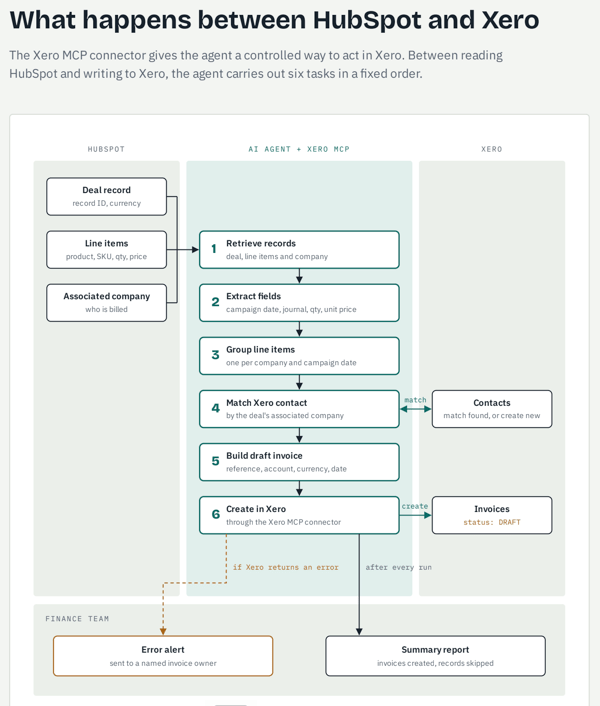
Seeking to address the operational bottlenecks, the company explored options to streamline and standardise invoice creation. After considering alternative solutions, they selected an integrated approach using HubSpot, a custom AI agent, and the Xero MCP connector.
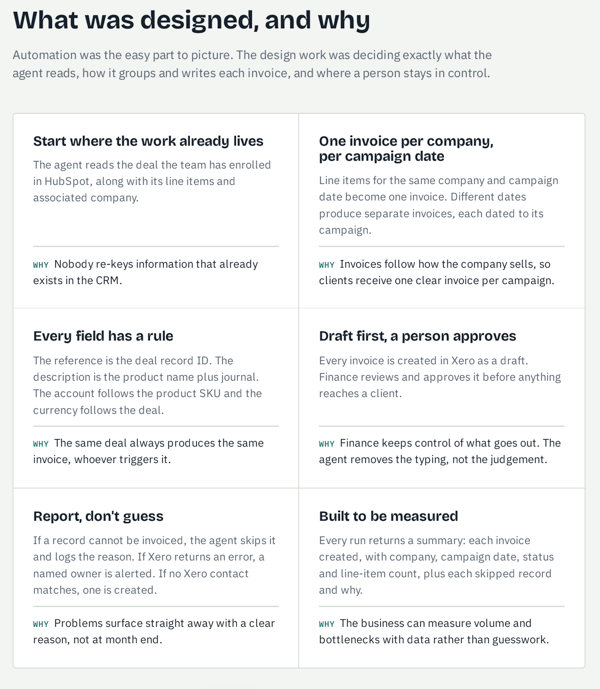 This workflow was specifically designed to group line items by campaign date, match invoices to the correct Xero contact, and generate each invoice as a draft ready for finance review. According to the client finance team,
"We save an hour on every invoice thanks to the new workflow, with fewer manual checks and clarification calls."
This approach enabled the company to move away from informal, memory-based processes and towards a system where every invoice is constructed from reliable, centralised data, significantly reducing the potential for errors.
The Results
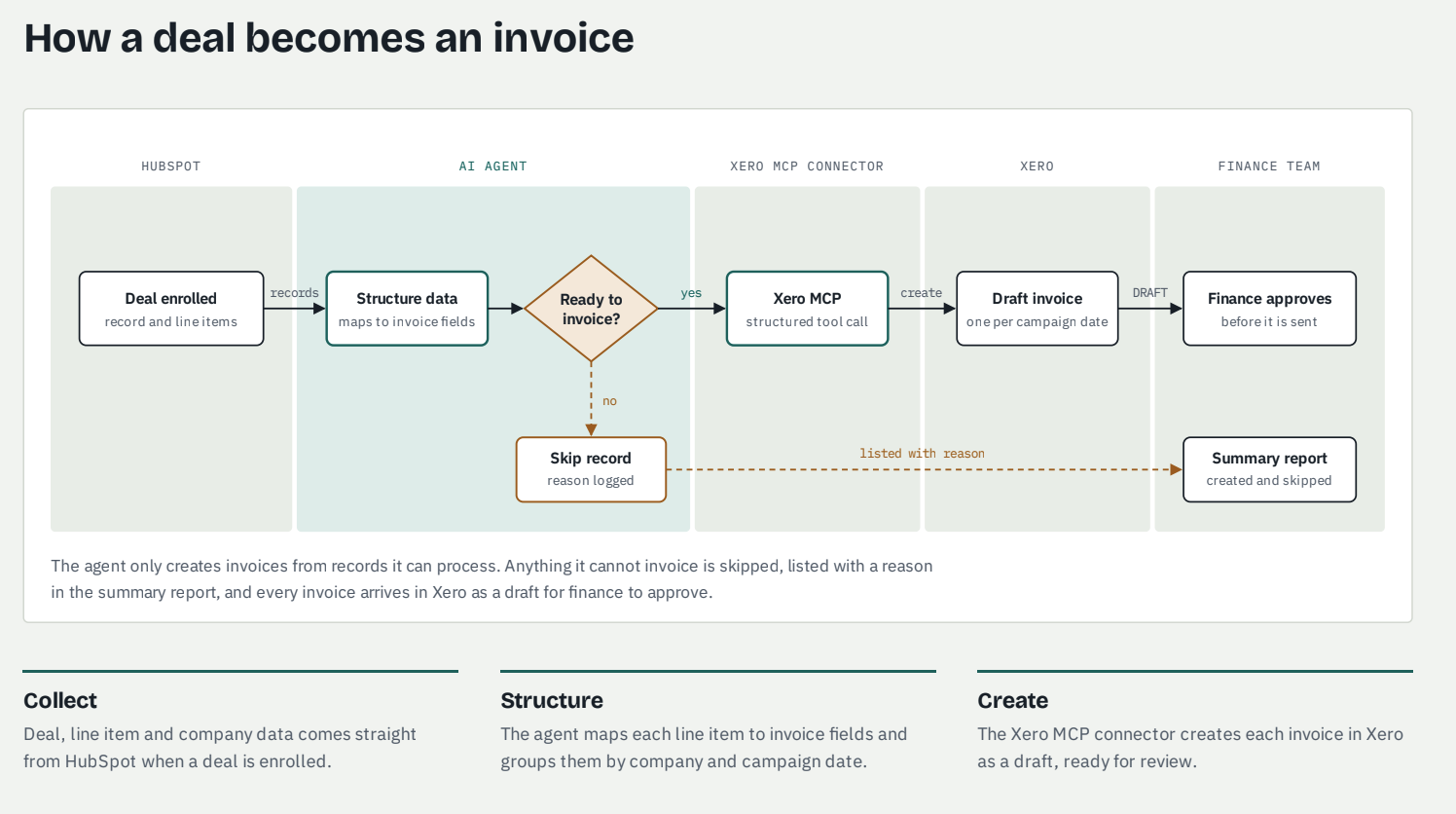
The implementation of the automated workflow delivered immediate and measurable benefits. Each invoice now requires one hour less to prepare, as reported by the client finance team.
Manual checks have been significantly reduced, and all invoice fields follow standardised rules to minimise errors and ensure consistency.
Reporting features now provide visibility into invoice creation volumes and identify any skipped records, supporting data-driven process improvement.
The finance team retains oversight by reviewing and approving draft invoices, ensuring that quality and compliance standards are maintained. Overall, the company has realised a scalable and robust invoicing process, aligned with industry expectations for efficiency and reporting transparency.
Ready to get started?