

Business Consulting
Understand what is driving your business before you change anything.


If your organisation uses HubSpot, you are already using AI. This is not a future consideration. It is your current reality.
HubSpot has embedded AI capabilities across its platform: predictive lead scoring, content assistants, email optimisation, conversation intelligence, and chatbots. Each of these features processes your data to make predictions, generate content, or automated decisions.
For many organisations, these capabilities arrived through platform updates rather than deliberate adoption decisions. Your marketing team may be using AI-generated subject lines without realising the compliance implications. Your sales team may be prioritising leads based on AI scores they do not fully understand. Your service team may be deploying chatbots that make commitments on your behalf.
This creates a governance gap. The AI is active, but the oversight may not be.
Webinar: AI Governance Managing Risk, Trust & Compliance
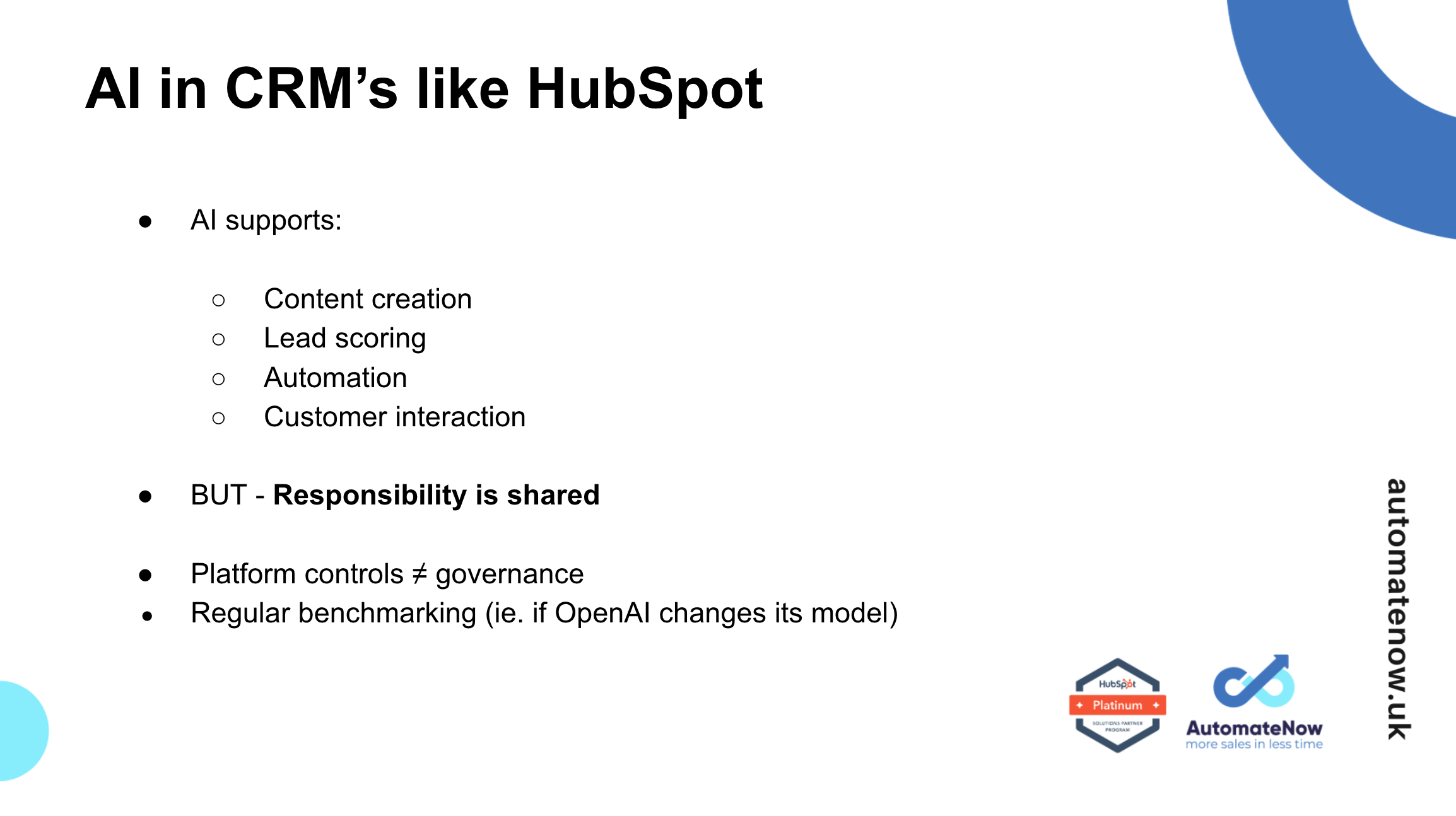
A critical concept for HubSpot governance is the shared responsibility model. HubSpot provides AI capabilities and certain controls, but your organisation remains responsible for how those capabilities are used.
HubSpot’s responsibility includes providing the technology, maintaining certain security standards, and offering configuration options. Your organisation’s responsibility includes determining which AI features to enable, what data AI can access, how outputs are reviewed before use, who has permission to deploy AI features, and monitoring for appropriate use.
This distinction matters because it clarifies where governance effort needs to focus. You cannot simply rely on HubSpot’s default settings and assume compliance. The platform gives you tools. How you configure and use those tools is your governance responsibility.
As Sam Easton notes: “HubSpot provides capability and some controls. But the organisation controls everything that matters for governance: data input, prompts, publishing approvals, permissions, deployment decisions, and monitoring. You cannot outsource accountability to your platform provider.”
Not all AI features carry equal risk. Understanding which capabilities warrant closer attention helps focus governance effort appropriately.
Predictive lead scoring uses machine learning to assess lead quality and likelihood to convert. This directly influences sales prioritisation and resource allocation. If the model contains bias or uses inappropriate signals, those patterns affect every scored lead. Governance questions include: Do you understand what factors influence scores? Are the factors appropriate and non-discriminatory? How are scoring decisions reviewed?
Content assistants and AI writing tools generate marketing copy, email content, and blog posts. Outputs require human review before publication, but the review process needs to be explicit and consistent. Generated content may contain inaccuracies, inappropriate claims, or material that does not reflect your brand voice or compliance requirements.
Chatbots and conversational AI interact directly with customers and prospects. They can make statements, answer questions, and potentially create commitments on your organisation’s behalf. The Air Canada case referenced in our Feb 26 webinar established clearly that organisations are responsible for what their chatbots say, regardless of the chatbot itself being a separate tool.
Email optimisation and send time prediction uses AI to determine when and how to send communications. While lower risk than decision-making AI, these features still process personal data and influence customer experience.
Conversation intelligence analyses calls and meetings to extract insights. This involves processing potentially sensitive communications and creating summaries that may be inaccurate or miss important context.
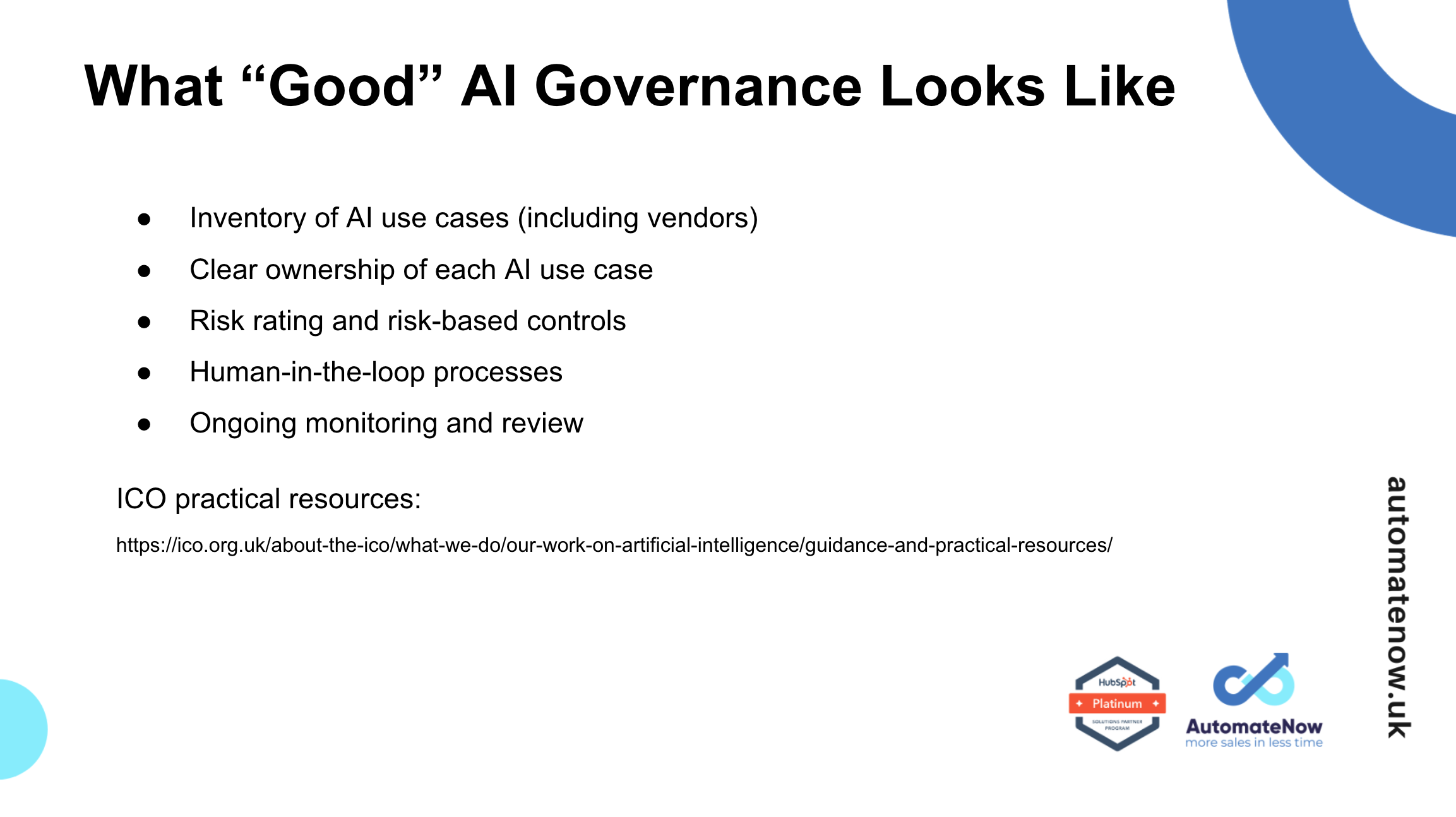
HubSpot provides several controls that form the foundation of AI governance. Super admins should review these settings and make deliberate decisions rather than accepting defaults.
AI feature enablement allows you to control which AI capabilities are active in your portal. Review each AI feature and decide whether it should be enabled for your organisation. Not every feature suits every business context.
Data access controls determine what information AI features can access. HubSpot AI can potentially access CRM records, conversation history, documents, and other stored data. Understand what each AI feature accesses and whether that access is appropriate.
User permissions control who can use AI features and deploy AI-powered tools. Not every user needs access to every AI capability. Align permissions with roles and responsibilities.
Privacy and consent settings include form consent management, legal basis tracking, and cookie controls. Ensure these are configured appropriately for your data processing activities, including AI use.
Machine learning model training opt-out allows organisations to request that their data not be used to train HubSpot’s machine learning models. Contact HubSpot’s privacy team if this is important for your organisation.
One often-overlooked governance consideration is model drift. HubSpot’s AI features use underlying models that may be updated without notice to users. When OpenAI or another model provider releases an update, the AI capabilities in your HubSpot portal may change in ways you did not anticipate.
This matters because outputs can change in tone, accuracy, or risk profile. Content that was appropriate last month may be generated differently today. Scores that were reliable may shift in ways that affect their usefulness or fairness.
Practical governance responses include documenting baseline performance for critical AI features, periodically spot-checking AI outputs against those baselines, and having processes to identify and respond to unexpected changes in AI behaviour.
Across all AI governance frameworks and regulatory expectations, one theme is consistent: meaningful human oversight is essential.
For HubSpot AI, this translates into specific practices:
Content review before publication. AI-generated content should be reviewed by a human before it reaches customers. This is not optional for compliance-conscious organisations. Establish clear workflows that prevent AI content from publishing without human approval.
Score validation and calibration. Predictive scores should be periodically validated against actual outcomes. If lead scores are not correlating with conversion, the model may need adjustment or the feature may not suit your context.
Chatbot monitoring and escalation. Automated conversations need human oversight. Implement monitoring for chatbot interactions and clear escalation paths for queries the chatbot cannot handle appropriately.
Regular output sampling. Periodically review samples of AI outputs across different use cases. Look for accuracy, appropriateness, consistency with brand standards, and compliance with legal requirements.
Human oversight does not mean reviewing every AI output. It means having proportionate review processes that catch problems before they cause harm and provide evidence of responsible use.
AI outputs are only as good as the data they process. For HubSpot AI, data quality directly affects governance risk.
Common data quality issues that create AI governance problems include inconsistent data entry standards, duplicate records with conflicting information, outdated information that has not been maintained, missing data that forces AI to make assumptions, and unclear definitions that mean different things to different teams.
Consider a simple example: if your definition of a “qualified lead” varies between sales and marketing, AI trained on historical data will learn an inconsistent pattern. The resulting scores may be technically accurate based on the data, but practically misleading for decision-making.
Data governance and AI governance are connected. Organisations that lack clarity on their data will struggle to govern AI effectively, regardless of what controls they implement.
A practical HubSpot AI governance approach includes several elements:
Documentation of which AI features are enabled, why they were enabled, what data they access, and who owns each capability.
Policies covering acceptable use of AI features, required human review processes, data handling standards, and escalation procedures.
Training for users on AI capabilities, limitations, risks, and governance requirements. People cannot follow policies they do not understand.
Monitoring through regular reviews of AI outputs, periodic audits of configuration settings, and tracking of any incidents or concerns.
Review cadence establishing when and how AI governance is reassessed. Quarterly reviews are typically appropriate for most organisations, with more frequent attention to high-risk capabilities.
Several patterns appear consistently in organisations that have not addressed HubSpot AI governance:
No inventory of AI use. The organisation does not know which AI features are enabled or being used. This is the most fundamental gap and must be addressed first.
Default settings unchanged. AI features were enabled with default configurations that may not suit the organisation’s risk profile or compliance requirements.
No human review for content. AI-generated content publishes without consistent human oversight, creating accuracy and compliance risk.
Unclear ownership. Nobody is specifically responsible for AI features, so problems are not identified or addressed.
No documentation. The organisation cannot demonstrate its governance approach to regulators, auditors, or customers who ask about AI use.
If you recognise gaps in your current HubSpot AI governance, these steps will improve your position:
This week: Identify every AI feature enabled in your HubSpot portal. Review the AI settings in your account to understand current configuration.
This month: Assign ownership for each AI capability to a specific person. Document what each feature does, what data it accesses, and what human oversight exists.
This quarter: Implement or improve human review processes for AI-generated content. Establish a baseline for AI output quality to enable ongoing monitoring.
Ongoing: Schedule quarterly reviews of AI governance. Update documentation as features change. Train new team members on AI policies and procedures.
Organisations with clear HubSpot AI governance can use AI capabilities more confidently and effectively. They adopt new features faster because they have frameworks to assess and manage risk. They build trust with customers who want assurance about how their data is used. They avoid the disruption and reputation damage that follow governance failures.
Good governance is not about restricting AI use. It is about using AI well, with appropriate oversight and clear accountability.
This article is for general information purposes and does not constitute legal advice. Organisations should seek appropriate professional guidance for their specific circumstances.
AutomateNow is a Diamond HubSpot Partner helping established businesses align their CRM, marketing and AI governance. Visit automatenow.uk to learn more.