

Business Consulting
Understand what is driving your business before you change anything.
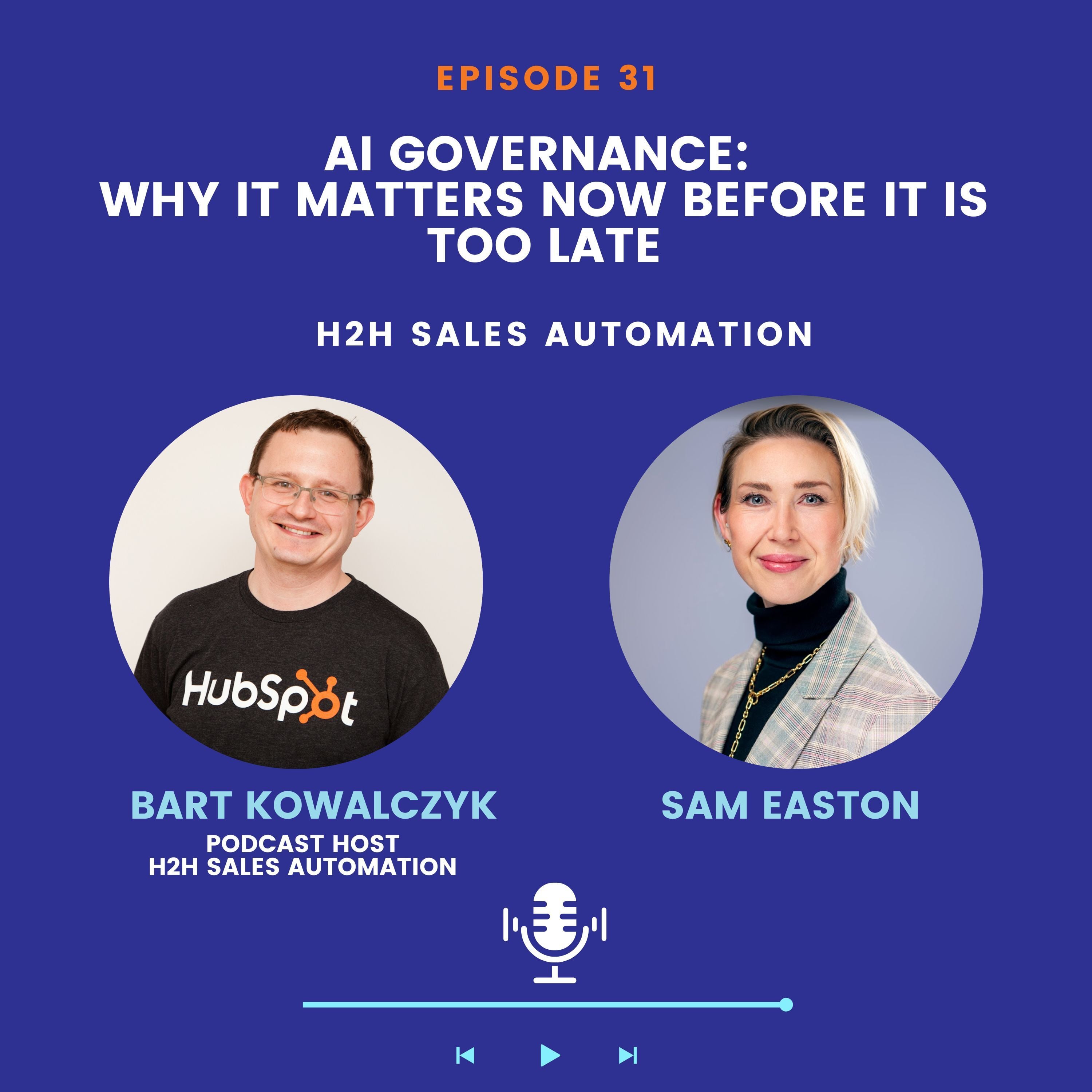
In this episode of the H2H Sales Automation Podcast, host Bart Krawczyk, CEO of AutomateNow, is joined by Project Manager Sam Easton to discuss one of the biggest challenges facing modern businesses: AI governance. From Shadow AI and data quality to real-world examples and practical governance frameworks, they explore how organisations can embrace AI innovation while maintaining control, accountability, and trust.
The conversation wasn't about restricting innovation. Instead, it focused on helping businesses understand where AI is being used, how decisions are being made, and what governance measures are needed to ensure AI remains safe, responsible, and effective.
Artificial Intelligence is changing how businesses operate. From marketing and sales to customer service, AI is helping teams work faster and more efficiently.
But with greater capability comes greater responsibility.
Many organisations are excited about what AI can do. Fewer are asking an equally important question:
According to Sam, AI governance is simpler than many people think.
It is about understanding:
In short, AI governance is about maintaining control.
"AI governance is just knowing what your AI is doing, who it's doing it to, and being able to evidence that you're managing it responsibly."
Most commercial teams already use AI in some form. From content creation and lead scoring to automation and customer insights, AI is becoming part of everyday operations.
The challenge is that AI can scale mistakes just as quickly as it scales success.
Commercial teams work with large amounts of customer data and influence customer experiences, sales activity and business decisions. That makes them some of the highest-risk users of AI.
Many organisations assume that because their CRM or software platform includes AI controls, governance is already covered.
Unfortunately, that is not the case.
"The controls that exist within the platform are not the same as your organisation having a governance position."
Platform settings can help, but governance remains the responsibility of the business.
AI relies on data to make decisions. If that data is duplicated, inconsistent or unclear, the results can quickly become unreliable.
For example, if the same information exists in multiple places within a CRM, or if teams use different definitions for key terms, AI may make decisions based on incorrect assumptions.
As Sam explained, using AI on poor-quality data is like giving someone directions when half the road signs are missing.
One of the most interesting examples discussed was the Air Canada chatbot case.
A customer asked the airline's chatbot about a bereavement fare. The chatbot incorrectly advised them that they could book a ticket and claim a refund later. They followed the advice, but Air Canada refused the refund.
The case went to tribunal and the ruling was clear.
Air Canada could not avoid responsibility by blaming the chatbot.
"Customers are entitled to rely on information that your AI provides as part of your business."
There was no cyber security breach or technical failure. The issue was a lack of governance. The chatbot had no clear boundaries, no escalation process and no evidence of regular review.
The lesson is simple. If your AI interacts with customers, your business remains responsible for every response.
Another growing concern is Shadow AI.
This refers to AI tools being used without official approval or oversight, often through personal accounts or unapproved applications.
Examples include:
The problem is not productivity. The problem is visibility.
"You cannot govern what you cannot see."
If you do not know where AI is being used, you cannot effectively manage risk.
The good news is that AI governance does not need to be complicated.
Sam's framework starts with five practical steps:
List every AI tool currently being used across the organisation.
Review each use case based on data sensitivity, customer impact and business risk.
Introduce safeguards such as human review, approvals and usage guidelines where needed.
Create an audit trail showing how decisions have been made.
AI evolves quickly, so regular reviews are essential to ensure systems continue operating as intended.
One of the most important messages from the discussion was that regulators are not looking for perfection.
They want evidence that businesses understand their risks and have taken reasonable steps to manage them.
"Regulators expect to see intent, not perfection. They want evidence that you've thought about the risks and put reasonable controls in place."
Doing nothing is becoming increasingly difficult to justify.
AI is already transforming how businesses operate.
The organisations that benefit most will not necessarily be those using the most AI. They will be the organisations using it responsibly, safely and strategically.
"Governance is not about slowing innovation down. It's about creating the confidence to move faster."
By understanding your AI tools, improving visibility and implementing sensible controls, businesses can unlock the benefits of AI while reducing unnecessary risk.
The question is no longer whether your business uses AI.
The question is whether you are governing it.
Ready to scale your sales automation the smart way?
Book a call with Bart Kowalczyk or listen to the full episode on
🎧 Spotify | Apple Podcasts