

Business Consulting
Understand what is driving your business before you change anything.


How real companies connect their systems, reduce chaos, and create a single customer journey.
If you run a manufacturing, engineering or production-heavy business, you already know the feeling: data is everywhere. Your ERP holds orders and product details. Finance has another system. Production runs on its own planning tools. Sales teams add information into spreadsheets or email inboxes. And your marketing team works hard just to understand what is actually happening with customers.
For many companies, HubSpot becomes the home for sales, marketing and customer relationship data. Your ERP manages everything that happens after the order. But the magic happens when the two finally talk to each other.
This guide explains how ERP–HubSpot integration works, what you need to prepare, what risks to avoid and how businesses benefit when the two systems begin working as one.

An ERP system (short for Enterprise Resource Planning) is the digital engine room of your business. It handles production planning, stock availability, purchasing, finance, orders, logistics, and in many cases, your entire operational process from raw materials to shipping.
ERPs were built to run the business.
HubSpot was built to grow the business.
The two systems serve completely different purposes, which is why so many companies eventually decide that connecting them is essential. Sales teams need visibility into stock levels, lead times and quotes. Operations teams need reliable customer information. Leadership wants one version of the truth.
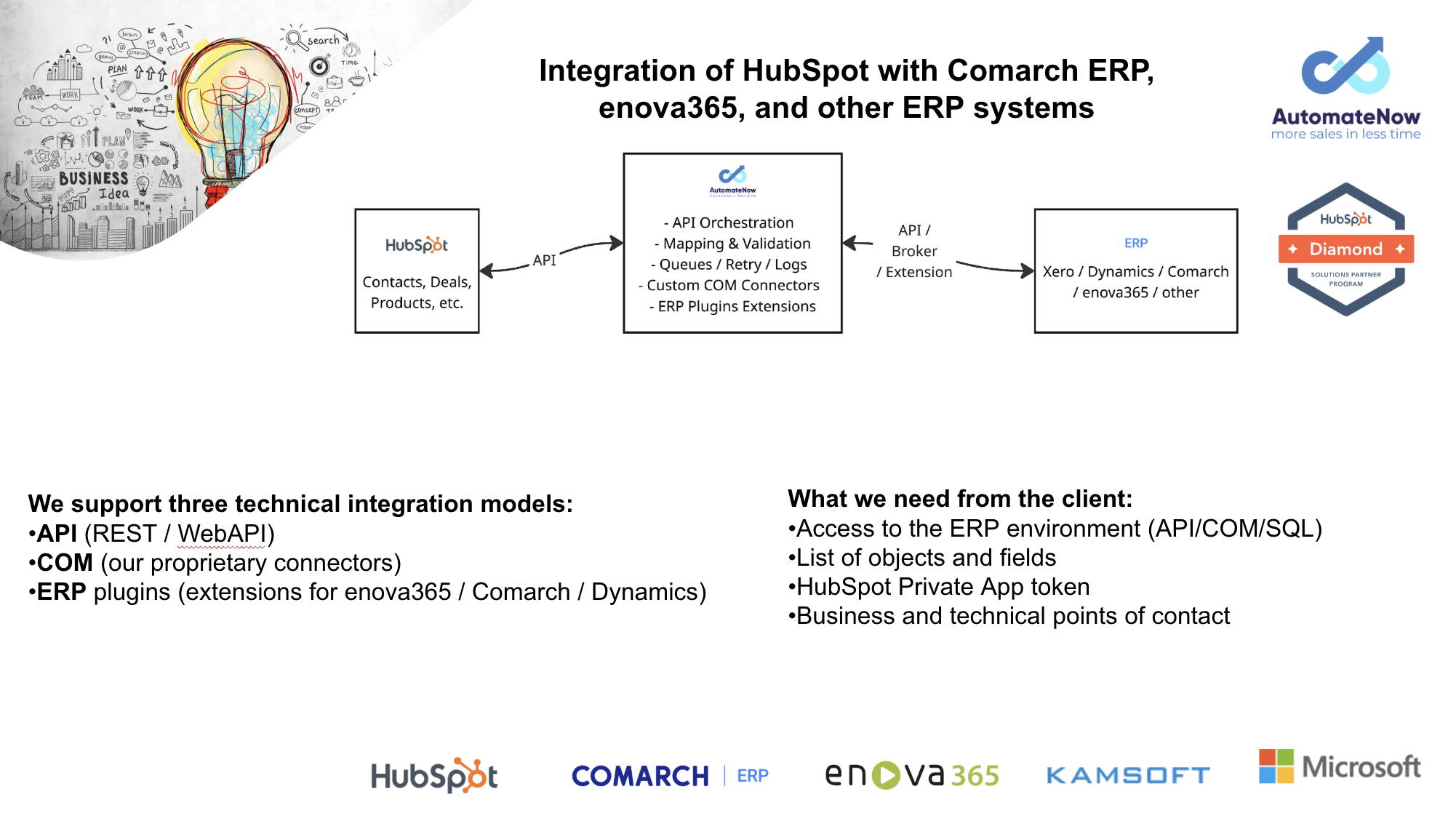
Process Mapping Example: HubSpot and ERP Integration
When the systems stay separated, people end up copying data manually, emailing screenshots back and forth, or spending hours double-checking information before making decisions.
Integration removes these barriers.
Most ERP providers offer a basic CRM module. In theory, this means sales and customer data could stay inside the ERP. In practice, it rarely works well.
ERP CRMs were not designed for modern customer relationships. They can be difficult to use, slow to update, and offer limited tools for marketing, automation, reporting or customer engagement. They were designed for internal processes, not for building long-term customer relationships.
HubSpot, on the other hand, focuses on the entire customer journey - from first website visit to long-term account management. Sales teams prefer its simplicity. Marketing teams rely on its automation. Leadership teams trust its analytics.
Connecting HubSpot to your ERP gives you the best of both worlds: operational reliability and customer-facing agility.
Imagine a potential customer requests a quote through your website. The sales team receives it in HubSpot, follows up, builds a deal and sends a proposal. Once the customer agrees, HubSpot sends the order information to the ERP. Production planning begins automatically. Stock is allocated. The order progresses through the factory. As it moves, the ERP updates HubSpot so sales and customer service can keep the customer informed.
The customer experiences a smooth journey.
Your team avoids duplicate work.
Managers gain visibility across the entire business.
This is what ERP–HubSpot integration enables.
The first step is understanding your own data. Not technically, but logically.
As Bart Kowalczyk at AutomateNow explains:
“Getting HubSpot ready for ERP integration starts with understanding your data flow. Identify which data you want to sync—customers, invoices, products—and in which direction it needs to move.”
This means asking simple but important questions:
Which system should control customer information?
Where should product data live permanently?
When an order is created, which system creates it first?
Who needs to see what, and when?
Answering these questions early removes 80% of the complexity later.
You do not need to understand APIs, servers or programming languages to get started. You simply need access to people who do—either internally or through a partner.
What you do need to prepare is more business-focused:
A clear understanding of your processes.
How do leads become customers? How do orders get created? What are the common exceptions?
A list of the information you rely on.
Products, inventory, customer data, order history, shipments—what actually matters to your business?
A commitment to clean data.
If you have duplicates, outdated records or mismatched formats, an integration will copy those issues into both systems.
Everything else—the servers, the API keys, the middleware, the error logs—can be handled by your integration partner.
Every ERP integration is different, but the common problems are surprisingly predictable:
Poorly defined data mapping.
If “customer” means one thing in HubSpot and something else in your ERP, the systems will argue with each other.
Syncing too much.
Not every field needs to sync. Sometimes less is more.
No testing environment.
Testing directly in your live ERP is extremely risky.
Skipping the planning phase.
The biggest failures come from companies who assume their ERP will work “out of the box” with HubSpot. It never does.
As Bart puts it:
“Proper data mapping and validation are essential to avoid errors. The most common mistakes are missing analysis or incorrect sync order.”
This is why expert guidance saves time and frustration.
For manufacturing and production-led companies, integration isn’t just about data. It’s about how people work.
When ERP and HubSpot are connected:
Sales teams stop guessing.
Production teams stop chasing information.
Customers receive faster, clearer updates.
Leadership gains visibility across forecasts, orders and capacity.
Teams stop wasting time on manual admin.
In other words, integration improves the way your whole business breathes.
AutomateNow’s brand values reflect this human-first impact, emphasising honesty, expertise, creativity, innovation and long-term business growth. Their approach is built around being trusted partners who solve real operational problems, not just technical ones.
No two ERPs are the same. Even two companies using the same ERP will have very different configurations. This is why generic templates or plug-ins rarely work.
To design an integration properly, you need to understand:
The shape of your data
The way your teams work
The complexity of your manufacturing or production processes
What your customers expect
What information each department needs
This is why AutomateNow encourages every business to start with a discovery call. A real integration must be designed specifically for your environment, your workflows and your goals.
As Bart says:
“Working with an experienced partner ensures a secure and efficient integration process.”
Whether you’re a manufacturing business, a tech company or a multi-system enterprise, integrating ERP with HubSpot can transform how your teams operate. It creates clarity, reduces manual work and gives customers a smoother experience.
If you’re interested in understanding what this could look like for your business, AutomateNow is here to help.
Every ERP integration is unique, and it starts with a conversation.
Created by AutomateNow experts (with AI assistance) to deliver quality content and maximise your HubSpot ROI.