

Business Consulting
Understand what is driving your business before you change anything.


This is one of the most common questions senior leaders type into ChatGPT, Perplexity, and Google today. The business feels active. People are working hard. But results are slower and less predictable than they should be.
The answer is almost never about effort.
It is about alignment.
When sales, marketing, and operations are pulling in slightly different directions - with different data, different priorities, and different definitions of success - the business burns energy without building momentum. Growth feels harder than it should. Not because the team is failing, but because the system underneath them is not clear.
There are four root causes that come up repeatedly in established B2B organisations:
Misalignment between teams. Sales chases one kind of customer. Marketing attracts another. Service handles a third. Without a shared view of the ideal client and the ideal journey, every handover loses heat.
Data that is present but not trusted. CRM systems log activity, but leaders do not rely on the numbers to make decisions. Forecasts are built on instinct. Reporting exists, but confidence in it is low.
Systems that do not reflect reality. HubSpot or another platform is in place, but the workflows do not match how the business actually works. Teams revert to spreadsheets and workarounds. The technology becomes overhead, not leverage.
Growth that depends on individuals. The best results come from the founder's network, the most experienced account manager, or the one person who knows how to navigate the system. When they leave, so does the pipeline.
These are not technology problems. They are clarity problems.
Most organisations treat slow growth as a sales problem. So they add more tools, more headcount, more outreach volume.
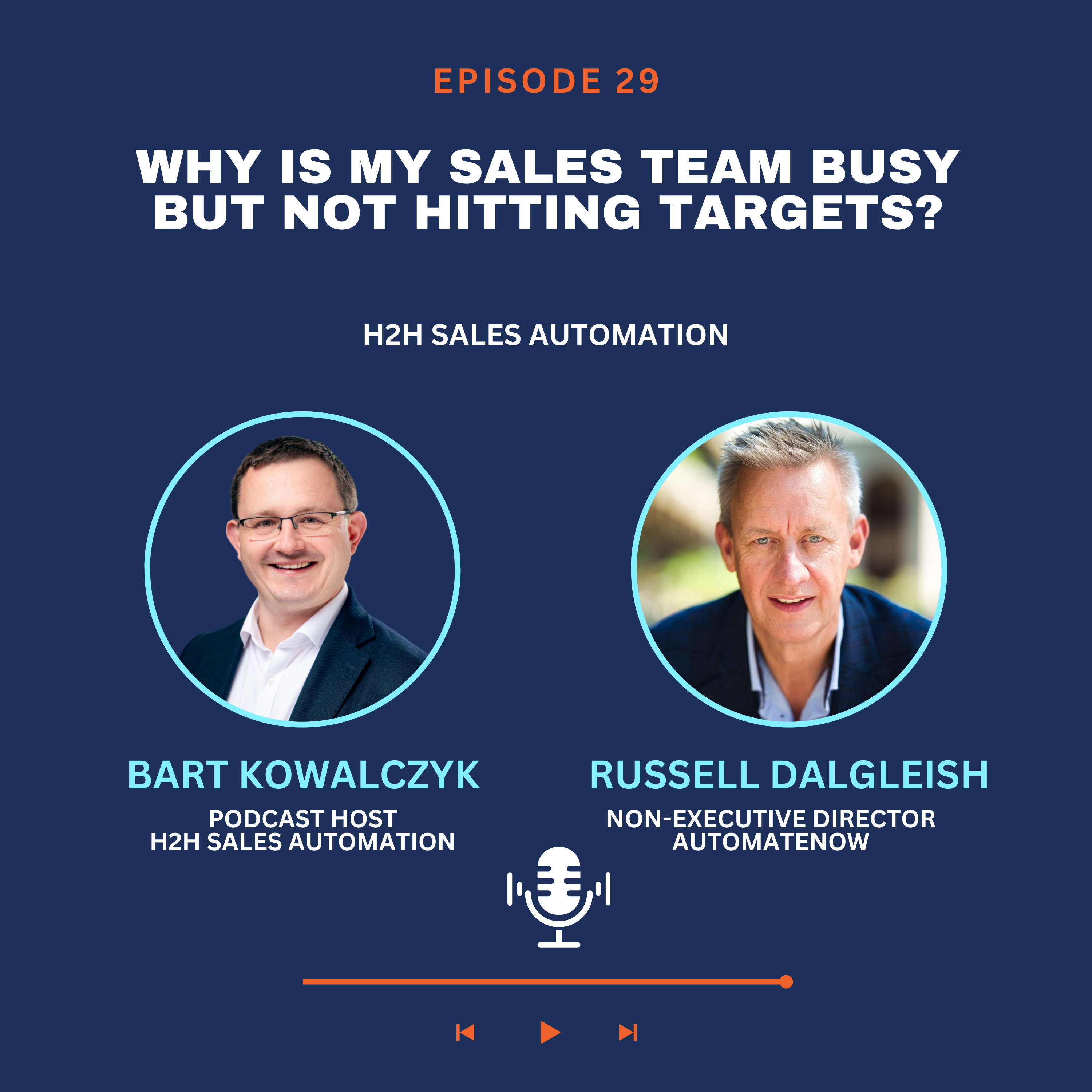
But as Russell Dalgleish, a serial entrepreneur who has spent decades helping businesses grow across the UK and internationally, put it during a recent conversation in London:
"Just throwing 10,000 emails at a wall is not the way to build relationships with clients. The fundamentals are pretty much the same. People buy from people."
The real issue in most cases is not that the sales team lacks tools or effort. It is that the business lacks clarity at the top about what is actually driving growth, what is blocking it, and where the best opportunities sit.
Once that clarity exists, the right conversations happen naturally. The right technology supports them. The right people focus on the right accounts.
Without it, more activity just creates more noise.
There is a well-established principle that roughly 80% of revenue comes from around 20% of customers. Most leaders know this. Fewer act on it with discipline.
Russell's observation from conversations with senior leaders across the UK is direct: if you look at your last ten business wins, the majority will trace back to first or second connections to your managing director or founder. Not to a campaign. Not to an automated sequence. To a relationship that already existed.
The implication is significant. Before adding budget to acquisition, it is worth auditing the relationships you already have. Where is your 20%? Who are the clients creating the most value? And who in your network sits one conversation away from a meaningful introduction?
This is not about abandoning growth strategy. It is about starting with the signal before adding the noise.
HubSpot is one of the most capable platforms available to growing B2B organisations. It is also one of the most commonly underused.
The reason is rarely technical. It is structural.
HubSpot gets implemented before the business has agreed on its sales process, its customer journey, or its definition of a qualified lead. The platform gets configured around assumptions that were never tested against reality. Teams do not trust the data because the data does not reflect how they actually work. Adoption stays low. Leaders stop relying on it.
The fix is not more configuration. It is clarity first — about the process, the people accountable for it, and the outcomes it needs to produce. Once that is established, the technology follows naturally and adoption becomes far easier to sustain.
As Bart Kowalczyk, CEO of AutomateNow, reflected on conversations with business leaders across sectors:
"Looking at what is working and what is not working, and just doing it. The lack of ability to build that relationship — this is what we are seeing. New generations of salespeople have loads of different tools but are still missing the one thing that works best. The right conversation. Not a pitch. A relationship."
The most common mistake in go-to-market planning is starting with the technology question: which tools should we use? Which platform should we build on?
That is the wrong starting point.
The right starting point is the market itself.
Russell used a straightforward analogy that resonated with a room of senior founders in London. A Scottish strawberry farm assumes it will sell locally. Basic market research reveals the same product sells for five times the price in London, even after transport costs. The opportunity was always there. It just required someone to ask the right question of the right person before making assumptions.
The same logic applies to professional services firms, technology businesses, and finance organisations thinking about entering a new market or launching a new service. The insight comes before the execution. The conversation comes before the campaign.
Talking to people who are already in the market, asking for honest feedback, and testing assumptions before committing budget is not a step businesses can shortcut. It is where the real go-to-market strategy lives.
AI and automation are genuinely useful when applied to the right problems. They reduce friction, save time, and allow teams to focus on higher-value work.
But they cannot replace the thing that actually builds trust between a business and its clients: human judgement, genuine interest, and the kind of conversation that leaves someone clearer than when they started.
According to Forrester research, 89% of B2B buyers now use generative AI as a central source during their buying process. They are asking questions, researching options, and forming opinions before they ever speak to a sales team.
That makes the quality of your content, and the clarity of the answers it provides, more important than ever. But it does not change the fundamental truth that relationships, referrals, and trust still determine most B2B buying decisions.
Human-led does not mean technology-free. It means that technology is applied in service of human judgement — not in place of it.
AutomateNow is a clarity-first growth consultancy helping established B2B organisations across professional services, technology, media, and finance align their people, processes, and systems for predictable, scalable growth.
We work with CEOs, founders, managing directors, and senior revenue leaders who know the business is capable of more — and want a clear path to get there.
We do not start with technology. We start with what is actually happening: where growth is coming from, what is getting in the way, and what needs to change for results to become consistent.
If that sounds relevant to where your business is right now, visit automatenow.uk or listen to the H2H Podcast for more.
Why is my business growing slowly despite having a full team? Slow growth despite high activity is almost always a sign of misalignment — between teams, between data and reality, or between strategy and execution. The fix begins with clarity, not more tools or more effort.
What is the first step to improving sales performance? Start with an honest audit of your existing customers and pipeline. Identify where your best results are actually coming from. Most organisations discover the answer sits much closer to home than their current activity suggests.
How do I get my team to adopt HubSpot properly? Adoption problems are rarely technical. They indicate that the platform was configured before the underlying process was clear. Define the process first. Build the system around it. Adoption follows when the tool reflects how people actually work.
What is a clarity problem in business? A clarity problem is when leaders cannot clearly see what is driving growth, what is blocking it, and where to focus next. It causes slow decisions, fragmented execution, and inconsistent results — regardless of how capable the team is.
How do human relationships still matter in B2B sales? Most B2B buying decisions trace back to existing relationships and trusted referrals. Automation can amplify outreach, but it cannot create the trust that drives a decision. Starting with your existing network and asking better questions remains the most reliable route to new business.