

Business Consulting
Understand what is driving your business before you change anything.


HubSpot has announced a huge wave of product changes this spring, with more than 100 updates focused on helping teams move faster with AI built directly into the platform. For many businesses, that sounds exciting - but also difficult to translate into day-to-day priorities.
That is exactly why we ran our recent webinar.
Led by Bart Kowalczyk, CEO of AutomateNow, on the 28th April 2026, the the session focused on a simple question: which HubSpot updates actually matter if you want to improve sales, marketing, and growth in a practical way?
Our conclusion was clear. Among all the announcements, two areas stand out immediately for growing B2B teams:
If your team is trying to do more with the same people, the same budget, and a higher expectation to use AI well, these are two updates worth paying close attention to.

HubSpot’s Spring 2025 Spotlight introduced more than 100 updates across the platform, with a strong focus on AI agents, workspaces, and practical execution.
The headline is not just “more AI”. It is AI with context.
HubSpot’s positioning this spring is that AI should not sit in isolated tools. It should work from the same customer context, business data, and team workflows already inside the platform.
That matters because disconnected AI may produce output quickly, but context-aware AI has a better chance of producing something useful.

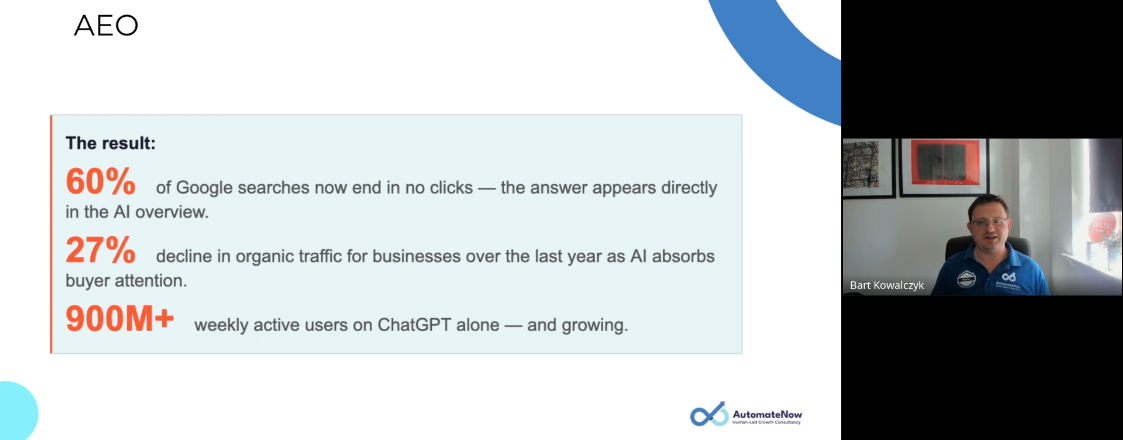
AEO stands for Answer Engine Optimization.
HubSpot defines it as the practice of optimising content so it can be surfaced by answer engines such as ChatGPT, Claude, and Gemini. In simple terms, this is about helping AI tools understand your business well enough to mention, cite, and recommend you when people ask relevant questions.
For years, marketers optimised for search engines. Now they also need to think about answer engines. That does not mean SEO disappears. It means search behaviour is changing.
People are increasingly asking longer, more specific questions and expecting direct answers. Instead of searching for a phrase and reviewing ten blue links, they are asking an AI tool for a recommendation, explanation, shortlist, or comparison.
For B2B teams, that shift matters because these visitors often arrive better informed and closer to a decision.
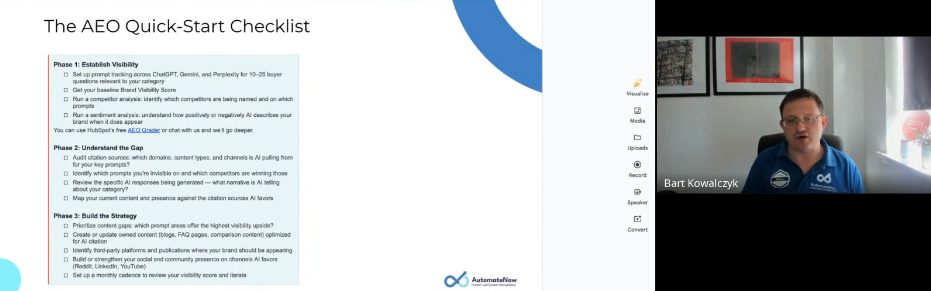
Your brand name
Domain
Brand name variations
Competitors
Products or services
ICPs
Prompts relevant to your market
From there, HubSpot runs tracked prompts daily against supported answer engines and reports on how visible your brand is over time.
Brand visibility
Prompt coverage
Sentiment
Share of voice
Competitor visibility
Citations and cited domains
Recommendations based on citation patterns 3 10 4
That last part is especially useful.
Rather than guessing what to publish next, teams can start to see what kinds of sources, formats, and topics answer engines are already citing in their market.
The value of AEO is not just visibility. It is visibility in the moment of intent.
When someone asks an answer engine for the best solution, the right implementation partner, or the most suitable tool for a specific problem, they are often much further down the decision process than someone casually browsing search results. That is why AEO matters commercially, not just technically.
HubSpot’s guidance is refreshingly practical here.
To improve the likelihood of content being surfaced by answer engines, HubSpot recommends:
using direct, concise, consistent language
structuring pages with clear heading hierarchy
using question-based sections where helpful
using numbered steps for processes
using bullet points for options
using tables for comparisons
adding schema markup
avoiding visuals as the main source of meaning
adding specific alt text to images 2 5
Specific rather than broad
Structured rather than rambling
Helpful rather than overly promotional
Written in human language, with clear answers near the top
One simple takeaway from the webinar: repurpose existing content before creating everything from scratch.
If you already have blog posts, service pages, webinar transcripts, client calls, or FAQs, that is often the best place to start. Improve the structure. Add direct questions. Clarify the answers. Build out FAQ sections. Turn spoken expertise into written content. That is often faster and more commercially useful than starting with a blank page.
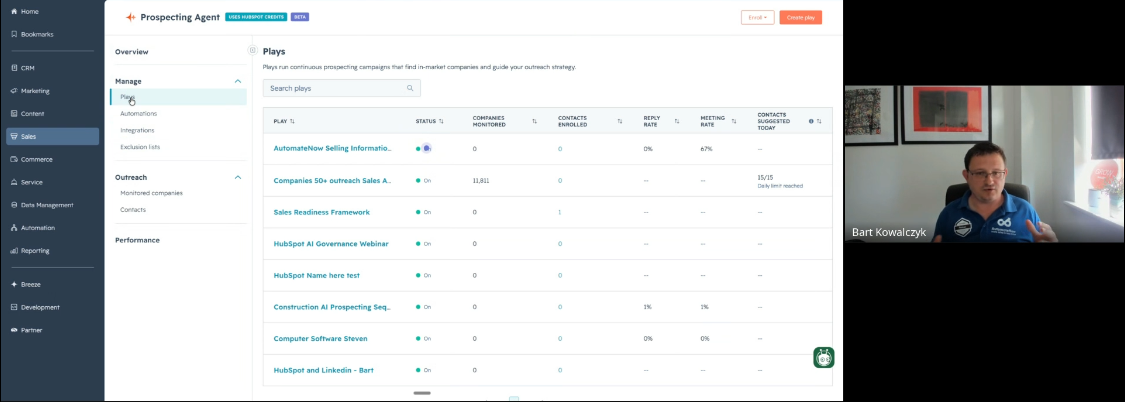
Prospecting Agent is HubSpot’s AI-powered prospecting capability designed to help sales teams research prospects, identify buying signals, find relevant contacts, and generate personalised outreach.
research target accounts
prioritise companies showing intent
identify relevant contacts and buying committees
generate personalised outreach based on CRM and external context 7 12
In other words, it is designed to reduce the manual work that usually sits between “we know this market matters” and “we are reaching out with something relevant”.
HubSpot says Prospecting Agent works through plays structured setups that define how the agent should research and conduct outreach for a given segment or use case.
Target audience
Personas
Selling context
Buying signals
Outreach method
Guardrails
Automation settings 13 12
It can monitor companies for signals such as relevant company activity, match those signals to your chosen audience, suggest contacts, and generate outreach drafts your team can review and send. That is important because the real advantage is not generic AI copy. It is context.
HubSpot’s Spring product messaging makes this point clearly: Prospecting Agent is more powerful because it is embedded in HubSpot and can use customer context, CRM history, and enriched research instead of working as a disconnected bolt-on tool.
Sales teams do not usually struggle because they have no prospects.
Identifying the right account
Understanding why now
Finding the right people
Writing the right message
Following up consistently
Prospecting Agent is interesting because it aims to compress that entire workflow.
For businesses with long sales cycles or multiple stakeholders, that matters even more. One of the strongest themes from the conversation after the webinar was not just outreach volume, but multi-threading understanding who is involved in a buying decision, where influence sits, and who actually holds budget or approval authority.
That is where better context and better contact mapping can make a real difference.
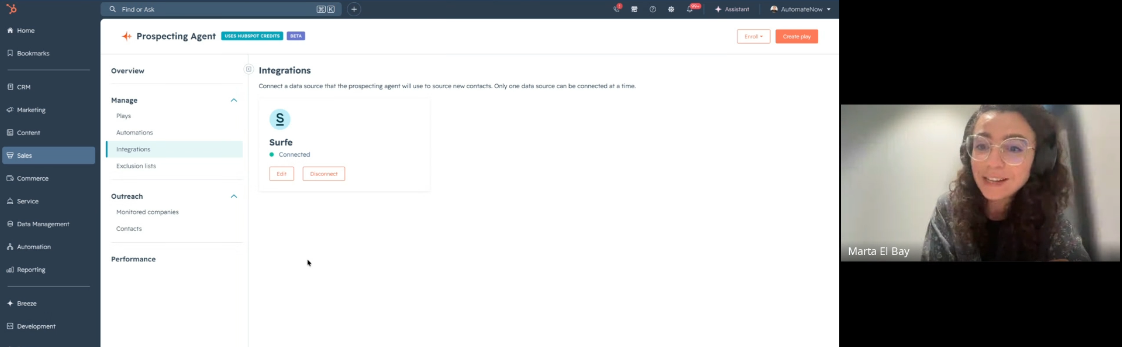
As Marta El Bay from Surfe pointed out during the session, tools can help surface the right contacts and enrich the data, but the quality of the result still depends on how clearly you define your target personas and selling context. That is where strategy still matters.
A practical view: what these updates mean for growing teams For us, the bigger story from Spring Spotlight is not feature volume. It is this: HubSpot is moving AI closer to day-to-day execution.
AEO helps marketing teams understand how their brand is represented in answer engines. Prospecting Agent helps sales teams move from broad prospecting to context-aware outreach.
clearer positioning
better visibility
stronger context
less wasted effort
more focused execution
Or as Bart put it during the webinar:
“Our job as partners is to bridge the gap between what tools and technology are producing every day and the business case for how you actually use them to bring more revenue.”
And that is the right lens.
The question is not whether AI exists. The question is whether your team is using it in a way that improves commercial outcomes.
If you are looking at these updates and wondering where to start, here is the approach we would recommend.
Look at your existing blog posts, service pages, landing pages, and FAQs. Are they clear, structured, and answer-led? If not, improve what already exists first.
Start with the actual questions your buyers ask across awareness, consideration, evaluation, and decision stages.
HubSpot’s AEO setup depends on brand details, product details, competitors, and ICPs. The better that input, the better the prompts and analysis.
For sales teams, be specific about target companies, personas, value proposition, and intent signals. Generic setups produce generic outputs.
The best use of AI is not “send more noise faster”. It is helping your team produce a better first draft, better research, and better timing with human judgement still responsible for quality.
There were a lot of updates in HubSpot this spring.
These are not just new tools. They reflect a bigger shift in how teams will create visibility and generate demand in the next phase of B2B growth. And if you get the setup right, they can help your team move with more clarity, not more noise.
“AI works best when it gives your team more context, not less control.”
AEO stands for Answer Engine Optimisation. In HubSpot, it refers to improving how your brand appears in answer engines such as ChatGPT, Claude, and Gemini.
HubSpot’s AEO tool tracks prompts daily after you define your brand, competitors, products, ICPs, and prompts, then reports on visibility, citations, sentiment, and share of voice.
No. AEO expands the way teams think about discoverability. SEO still matters, but content now also needs to be easy for answer engines to interpret and cite.
Prospecting Agent is HubSpot’s AI-powered sales capability designed to research accounts, identify buying signals, find relevant contacts, and generate personalised outreach.
Because it helps reduce manual prospecting work and improve relevance by combining intent signals, account research, and CRM context.
Created by AutomateNow experts (with AI Assistance) to help you work smarter and maximize your HubSpot ROI