

Business Consulting
Understand what is driving your business before you change anything.
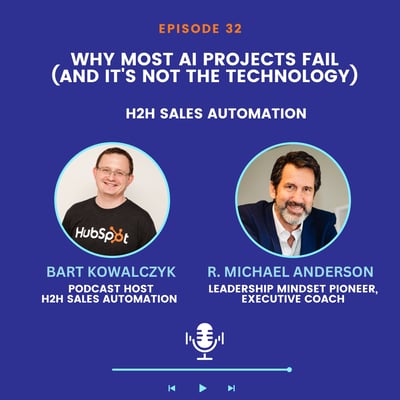
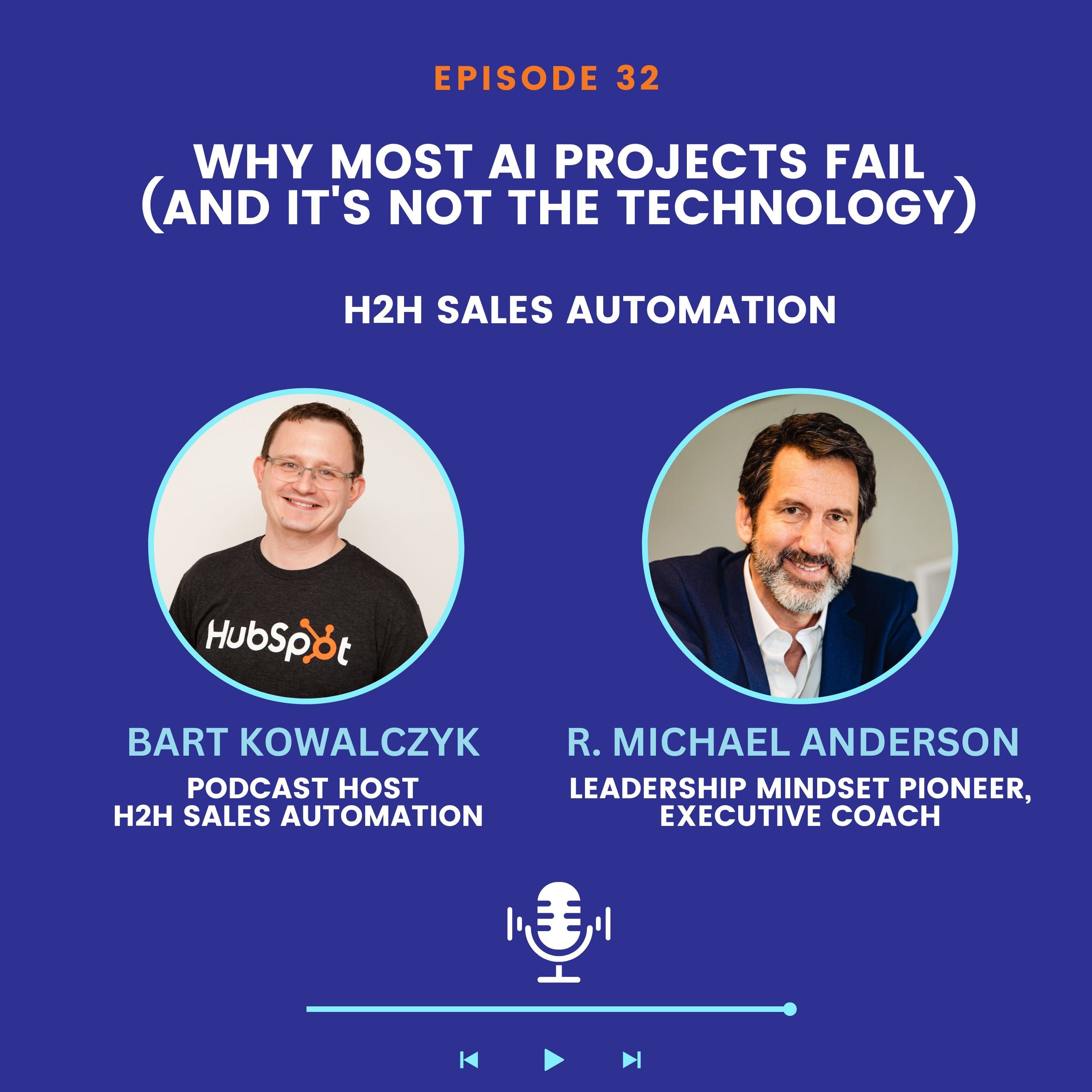
In the latest episode of the H2H Sales Automation Podcast, host Bart Kowalczyk sat down with Executive Coach, Leadership Consultant and Keynote Speaker R. Michael Anderson for a conversation that cuts through a lot of the AI hype.
The two met at an event in London, bonding over a shared interest in how AI is reshaping leadership. Their 20-minute chat covers a lot of ground, but the central message is simple: the reason most AI projects fail has very little to do with the technology itself
Anderson didn't hold back on the numbers. According to his research, only around five percent of generative AI pilots ever have a positive impact on the bottom line. Just 27 percent of executives can point to any measurable gain from their AI projects at all, and most of the investment isn't going where it needs to.
"93% of the budget is going to AI tools and AI-specific skills, and only 7% to people and processes."
That imbalance, Anderson argues, is the root of the problem. Having spent 25 years implementing ERP systems before moving into leadership consulting, he's seen this pattern before. Enterprise software that genuinely transforms a business, he says, needs at least half its energy spent on people and process, with the technology treated as a tool rather than a fix.
Bart asked the obvious question: why are so many organisations jumping into AI without a clear plan? Anderson's answer came down to human nature, and specifically, fear of missing out.
"The board told me I have to implement AI right now."
That's the sentence Anderson says he hears from CEOs again and again, usually followed by silence when he asks what the board actually wants AI to achieve. His research suggests 64 percent of CEOs have implemented AI because of board pressure rather than a genuine business case. The same pattern repeats further down the chain, with sales managers and directors reluctant to admit they haven't adopted AI in case it makes them look like they're falling behind.
The deeper issue, he explains, is that AI is often mistaken for a fix when it's really an accelerator.
"If you have a dysfunctional team or your team are siloed, the AI is going to accelerate that... it's not a band aid and it's not going to fix what's already broken."
Anderson's own path helps explain his perspective. He started out as a programmer and project manager, founded and later sold three software companies, then realised leadership wasn't coming naturally to him. That prompted a master's in psychology and a neuroscience certificate, followed by 25 years working on ERP implementations across finance, distribution and manufacturing.
That combination, technologist and leadership specialist, is what shaped his recent white paper and a keynote he'd just delivered in Boston called "Human Leadership in an AI World". It's also why Bart wanted him on the podcast: Anderson isn't an AI consultant who arrived with the trend. He came to it from decades of watching enterprise technology succeed or fail based on the people around it, not the software itself.
Bart shared a parallel from AutomateNow's own world, drawn from a recent HubSpot EMEA Partner conference in Dublin, where the message to partners was to pilot small and take tiny steps rather than attempt a wholesale transformation. Anderson agreed, but added an important caveat: the companies getting real results aren't just running small pilots, they're running the right ones.
His advice for leaders is to pick one or two business processes rather than eighteen, and crucially, to ask the team what's actually eating their time.
"What's the hardest part of their job? What takes the most time? What's the most boring, repetitive, frustrating part?"
He's also careful to separate two very different layers of AI adoption. There's personal productivity, the everyday use of tools like Copilot or Claude to clean up email or summarise a meeting, and there's agentic AI, which takes over entire business processes. The second category, he warns, needs far more caution, because leaders rarely understand the fine detail of a process the way the people doing it every day do.
Bart offered a view from the ground, describing what AutomateNow observes across its HubSpot client base. Younger team members tend to pick up tools like HubSpot's Breeze agent quickly, often solving a specific, well-defined problem such as replacing a manual pricing chat with a guided knowledge base response. Longer-serving staff are more hesitant, understandably wary of what AI adoption might mean for their role.
The pattern, Bart suggested, only shifts with time and the right culture, one where leadership is genuinely open to experiments that don't work out, and where the focus stays on freeing up time for better customer relationships rather than simply doing more, faster.
Anderson picked up on that point immediately.
"What are you going to do with the time you save?"
If AI hands someone back three or four hours a week, he argues, that time needs to be deliberately redirected towards something that moves the business forward, whether that's building referral relationships or deepening customer connections, rather than filling up with busywork.
One of the more striking parts of the conversation was about authenticity. Anderson admitted he's grown wary of LinkedIn and Facebook posts that feel generated, and actively skips over content he suspects came straight out of an AI tool.
"If it's AI, I'm like, well they probably just cranked something out."
His advice for leaders is blunt: never send your team AI-generated newsletters or emails written entirely by a tool. When people sense they're being spoken to by a computer rather than a person, disengagement follows fast. He's not against using AI to soften a difficult message or tidy up phrasing, but the substance needs to stay in the leader's own voice.
Anderson broke leadership down into three areas: functional expertise (finance, marketing, sales, depending on the role), management (running projects, handling evaluations) and leadership itself (vision, culture, accountability, complex decision-making). AI, he argues, is going to significantly streamline the first two. It's the third, genuine leadership, that stays firmly human, at least for the foreseeable future.
"If you're not good at those things, then your job is at risk."
Bart asked about the different dynamics he'd noticed in Anderson's white paper across regions. Anderson was careful to flag these as broad generalisations, but the pattern he described was clear. American companies tend to pilot AI enthusiastically, often before fully thinking it through. European organisations, UK included, are more constrained by privacy and governance regulation, which slows adoption but forces more scrutiny. The Middle East is a different story again: governments there are actively pro-AI, but many businesses are still building the underlying process maturity and psychological safety needed to make agentic AI work, particularly given a historically top-down management style.
The conversation closed with practical, actionable advice for any mid-sized business leader wondering where to start.
First, model the behaviour. Leaders don't need to be AI experts, but they do need to be visibly experimenting, including admitting when something doesn't work.
Second, empower middle managers. Anderson pointed to what he calls the "frozen middle", where pilot projects often stall not because managers resist them, but because nobody is listening to their feedback or giving them the authority to act on it.
Third, be honest with the team about what AI adoption means for their roles, even when that conversation is uncomfortable.
"Chances are half of you are going to lose your job in the next six months... I know that's hard, but you're a leader. This is what you're going to do."
Finally, Anderson suggested a concrete exercise: a 90-minute session where the leader acts as facilitator rather than presenter, asking the team to identify their most boring, repetitive tasks and design a two-week AI experiment around one of them. He calls it a "manager application sprint", and the key is that the team owns the solution, not the leader.
For leaders who want to go deeper into the mindset shifts behind all of this, Anderson's book, Leadership Mindset 2.0: The Psychology and Neuroscience of Reaching Your Full Potential, sets out 48 practical skills and habits for moving from tactical expert to strategic leader, drawing on the same psychology and neuroscience background referenced throughout this conversation.
You can find more of his keynotes, coaching programmes and writing, including his recently added "Human Leadership in an AI World" talk, at rmichaelanderson.com.
Michael's closing message was one of patience rather than urgency.
"We're at the start of a 25-year transformation... take it with everything with a grain of salt."
For sales and marketing leaders navigating AI adoption, the episode's core argument is worth sitting with: the technology is rarely the bottleneck. The real work lies in process, culture and honest, human leadership, exactly the areas AI can't replace.
Ready to scale your sales automation the smart way?
Book a call with Bart Kowalczyk or listen to the full episode on
🎧 Spotify | Apple Podcasts