


Business Consulting
Understand what is driving your business before you change anything.

Most growing businesses are doing a decent job of capturing contacts. Newsletters are running. Webinars are filling up. Forms are converting. The database grows month by month, and on paper that feels like progress. But when teams actually try to use that data, a quieter problem shows up: they don't really know who these people are.
As Rebecca from the AutomateNow team put it during a recent conversation:
“You’ve put all this effort into capturing contacts, and then you’re not really using the data properly. That’s the missed opportunity.”
In most organisations, the typical contact record contains very little beyond a name and an email address. Sometimes there's a company name. Often that's where it ends. At first this doesn't feel like a problem. The contact is "in the system." But the moment sales or marke1ting wants to do something meaningful (personalise outreach, segment campaigns, plan regional activity, or understand who's engaging) the limitations become obvious.
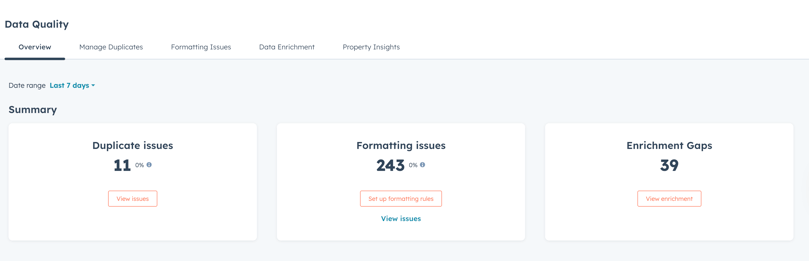 Data Quality Dashboard in HubSpot
They don't know where people are based, what roles they hold, or how senior they are. They can't easily distinguish between a decision-maker and a casual subscriber. Campaigns stay broad, outreach feels generic, and opportunities that should feel warm remain frustratingly vague. The hardest part has already been done: earning attention and capturing interest. What's missing is the ability to act with confidence.
This goes beyond marketing convenience. When your data lacks depth, sales teams spend time chasing the wrong people or reaching out at the wrong moment. Marketing struggles to move beyond one-size-fits-all messaging. Leadership sees activity without insight.
The effort to acquire these contacts has already been paid for through content, events, time, and budget. The real cost shows up later, as missed opportunities rather than obvious failures.
Rebecca summed it up simply:
“The data isn’t pointing you in the right direction of what you could do next.”
When enrichment is done properly, the database stops being a static list and starts behaving more like a living system.
Contacts entering HubSpot are enriched automatically in the background. Key information (location, role, seniority, industry) gets filled consistently without manual effort from the team. Existing records are cleaned up and standardised so reporting finally makes sense. Over time, patterns emerge. You can see where interest is coming from geographically. You can understand which roles are engaging with which topics. You can identify segments that deserve more attention or less.
Just as importantly, the data stays current. When someone changes role or company, that signal becomes visible instead of hidden. Outreach becomes timely and relevant rather than awkward or outdated.
One media organisation we worked with had built a large audience over time: more than 40,000 contacts across newsletters and publications. Most records contained little more than a name and email address. There was no clear picture of who was actually engaging, where they were based, or what level of seniority they represented.
After cleaning and enriching the database, the picture changed. Over 22,000 contacts were enriched with consistent fields covering region, seniority, and industry. For the first time, the team could see the real makeup of their audience. That clarity reshaped how they thought about content, segmentation, and future growth. They moved from guessing to responding to what the data was actually telling them.
Data enrichment isn't about creating the "perfect" CRM. It's about respect for the effort you've already put in. If your database is growing but your insight isn't, the issue usually comes down to clarity rather than ambition, effort, or tooling. Clarity changes how teams move, how leaders decide, and how opportunities surface.
If this sounds familiar, start with a simple question: what does our data actually allow us to do today, and what should it be enabling tomorrow?