

Business Consulting
Understand what is driving your business before you change anything.


A prospect downloads your guide, receives a welcome email and joins a nurture campaign. Before the next scheduled message, they ask about implementation and visit your service pages. Does your process recognise that change, or keep sending the same introductory content?
Revenue-focused automation should help your team make a better decision about what happens next. At AutomateNow, we approach B2B marketing automation through the customer journey, the data available and the people responsible for responding.
This guide develops three ideas from the webinar Marketing Automation That Drives Revenue, presented by Calvin Chee and Bart Kowalczyk on 30 October 2026: behaviour-led nurturing, intent-based sales handovers and customer retention signals. Implementation examples are suggestions to test, rather than universal benchmarks or promises of revenue growth.
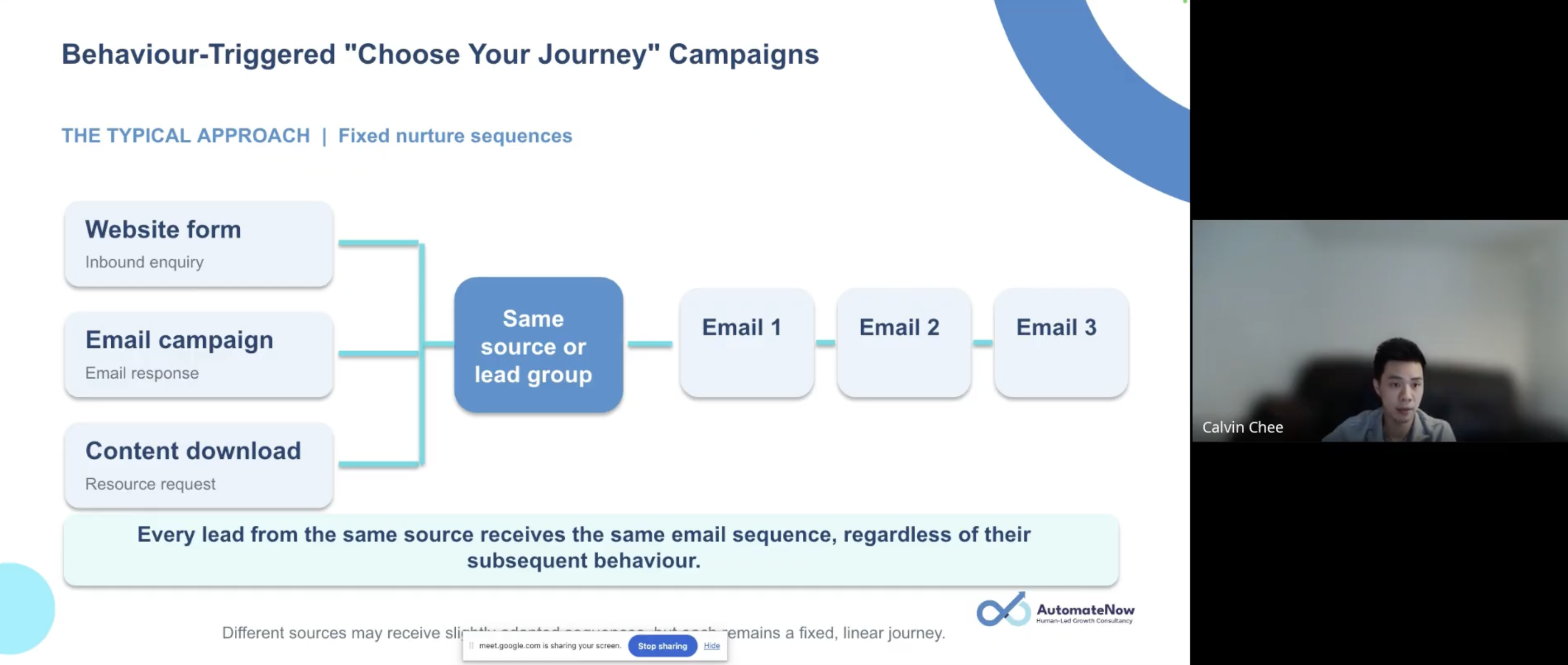
A sending schedule tells you when a message should go out; it does not tell you whether the recipient is ready to speak to sales. Someone researching next year's budget can download the same guide as someone looking for a supplier this month.
A standard welcome campaign can still provide a useful foundation. The problem arises when the campaign ignores a direct reply, a new enquiry or a sales conversation already in progress. Your system may complete its sequence while the customer waits for help with a different question.

Start with the decision you want to improve. It might be choosing the next topic, identifying a useful time for a conversation, or flagging an account that needs support. An instruction to send more messages leaves those decisions undefined and makes success difficult to assess.
Map the entry point, available evidence, next action and person responsible. AutomateNow's customer journey design work connects these touchpoints across marketing, sales and service. That shared view matters because the customer experiences one relationship, even when several teams are involved.
Behaviour-led nurturing adapts communication to what you learn about the recipient. A first message might deliver a requested resource. Later messages can follow the topic the person has shown interest in, provided you have enough reliable context to make that choice.
During the webinar, Calvin Chee contrasted a fixed welcome series with journeys that respond to activity between messages. The practical opportunity is to use information gathered after the initial enquiry, instead of treating the original acquisition source as a complete description of someone's needs.
Consider a UK consultancy offering systems integration and reporting support. A contact initially downloads a general guide, then asks how customer data will move between finance and CRM. An integration example and a preparation checklist would be more relevant than another broad introduction.
Another contact might ask how leadership can trust pipeline reporting. Their next resource could explain definitions, ownership and the questions to agree before building a report. These are illustrative routes: neither a single page view nor a download proves that the contact is ready to buy.
A default route should explain what happens when no new information appears. Depending on the relationship and communication permissions, you might send a useful general resource, ask about preferences, reduce frequency or end the campaign. Silence should not automatically trigger more persistent follow-up.
Also decide how interests expire and how conflicting signals are handled. A direct answer about priorities should usually carry more weight than an older inferred interest. Specify when a campaign stops, particularly when a contact becomes a customer or starts a conversation with a salesperson.
Useful personalisation helps a recipient answer a question. It might change the example, explain a relevant implementation issue or suggest an appropriate next step. Repeating a company name throughout an otherwise generic message does little to improve the substance of the communication.
Avoid unnecessarily narrating everything you have tracked. The recipient needs relevant help, not a recital of their browsing history. Review personalisation from their perspective: is the message accurate, appropriate to the relationship and useful enough to justify the attention you are asking for?
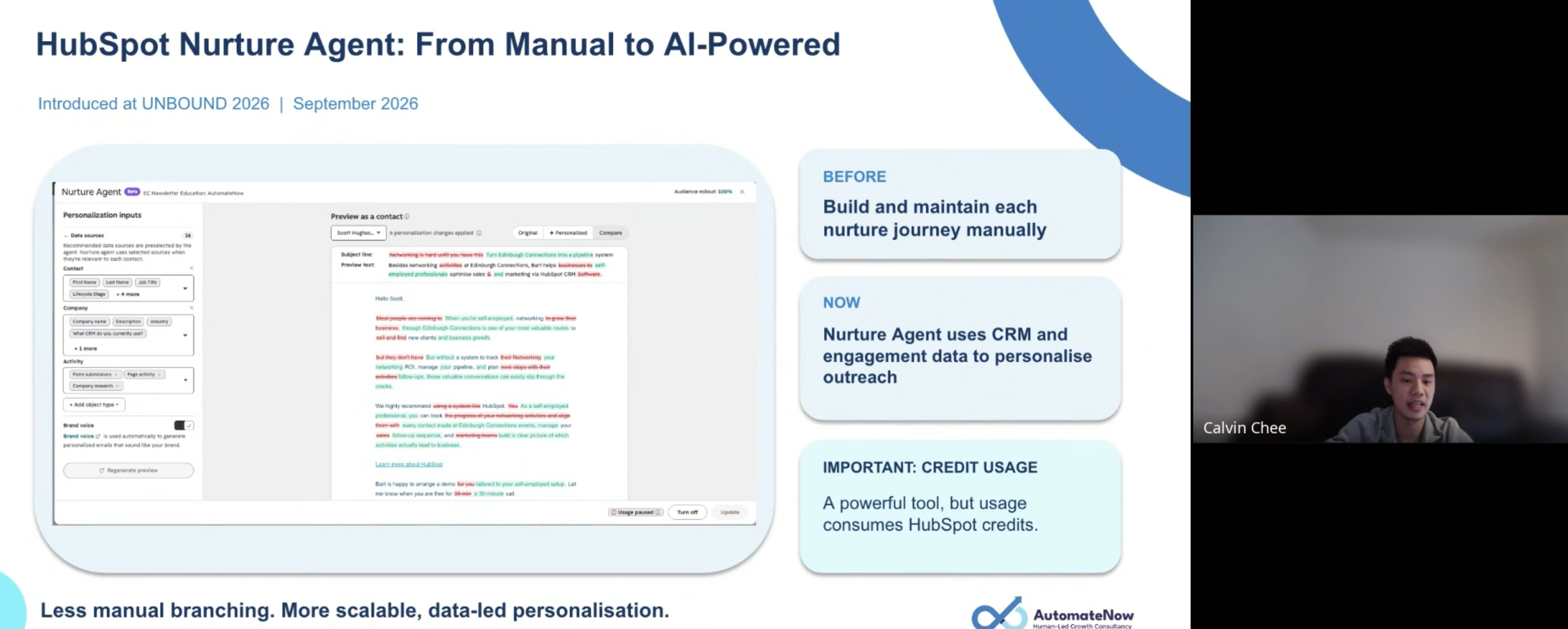
HubSpot Nurture Agent personalises automated marketing email text using selected CRM information and web research. The official Nurture Agent documentation describes kum ds juunzxoilas subject lines, preview text, calls to action, and email body content.
Personalising text and choosing the customer journey are separate decisions. Your rules determine who receives a message and when. The agent can adjust what that message says. Both need a clear purpose, appropriate data and a reliable fallback when information is incomplete.
Test contacts with detailed histories, sparse records and ambiguous context. Check whether the message remains factually correct, reflects your services and uses appropriate language. A message should not turn an unverified assumption into a statement about the recipient's business or expose confidential internal notes.
Provide a clear base email and specific communication boundaries. Check examples against your brand and commercial commitments, especially claims about results, delivery scope or regulated topics. Human review should establish what acceptable output looks like and when the pilot needs to be paused.
Nurture Agent consumes HubSpot Credits when personalised emails are sent; generating previews does not consume those credits. Its documentation describes monthly credit limits and controls over the proportion of recipients receiving a personalised version. Check current credit rates in HubSpot's catalogue before setting a budget.
Compare the cost with the quality of replies and subsequent outcomes. The webinar included encouraging early engagement observations from a small internal test, but did not establish a causal revenue impact. Treat early improvement as a reason for further testing, rather than a forecast you can apply to every campaign.
Pass a lead when agreed evidence suggests that a sales conversation would be useful. Completing a nurture sequence does not establish that evidence. A request for an implementation discussion, an explicit project deadline or a direct enquiry can carry a different meaning from an isolated content click.
Calvin's second webinar idea was to let credible intent interrupt the fixed timetable. Someone ready to talk after the first message should not have to wait for several more. Equally, reaching the final message should not force an unsuitable contact into a salesperson's queue.
Fit concerns whether the organisation and need match your offer. Activity concerns what the contact has done recently. A highly active reader may be a student, competitor or existing customer researching something unrelated to a new purchase. Activity alone cannot resolve those distinctions.
Agree a small set of candidate signals with sales, then review how they relate to accepted opportunities. If you use points, treat the weights as hypotheses. AutomateNow's sales automation roadmap reinforces the value of starting with the process and improving it through team feedback.
The handover should explain why this contact deserves attention now. Include the relevant question, recent meaningful activity, known business need and any existing conversation. Assign an owner, an agreed response expectation and a backup route when the usual salesperson is unavailable.
Keep the next action specific. An implementation enquiry might need a scoping conversation, while a technical question could require a specialist response first. The salesperson should understand the evidence and retain the ability to challenge the recommendation rather than treating a score as a verdict.
Sales should be able to return a contact with a meaningful reason: wrong timing, insufficient need, poor fit or further education required. That reason should inform the next campaign decision. Otherwise, the same contact may repeatedly cross the threshold without anything useful changing.
Review both successful and unsuccessful handovers. Check whether the issue was the trigger, the content, the customer fit or the speed and quality of the response. Improving those distinctions gives marketing a more useful brief than a general complaint that lead quality is low.
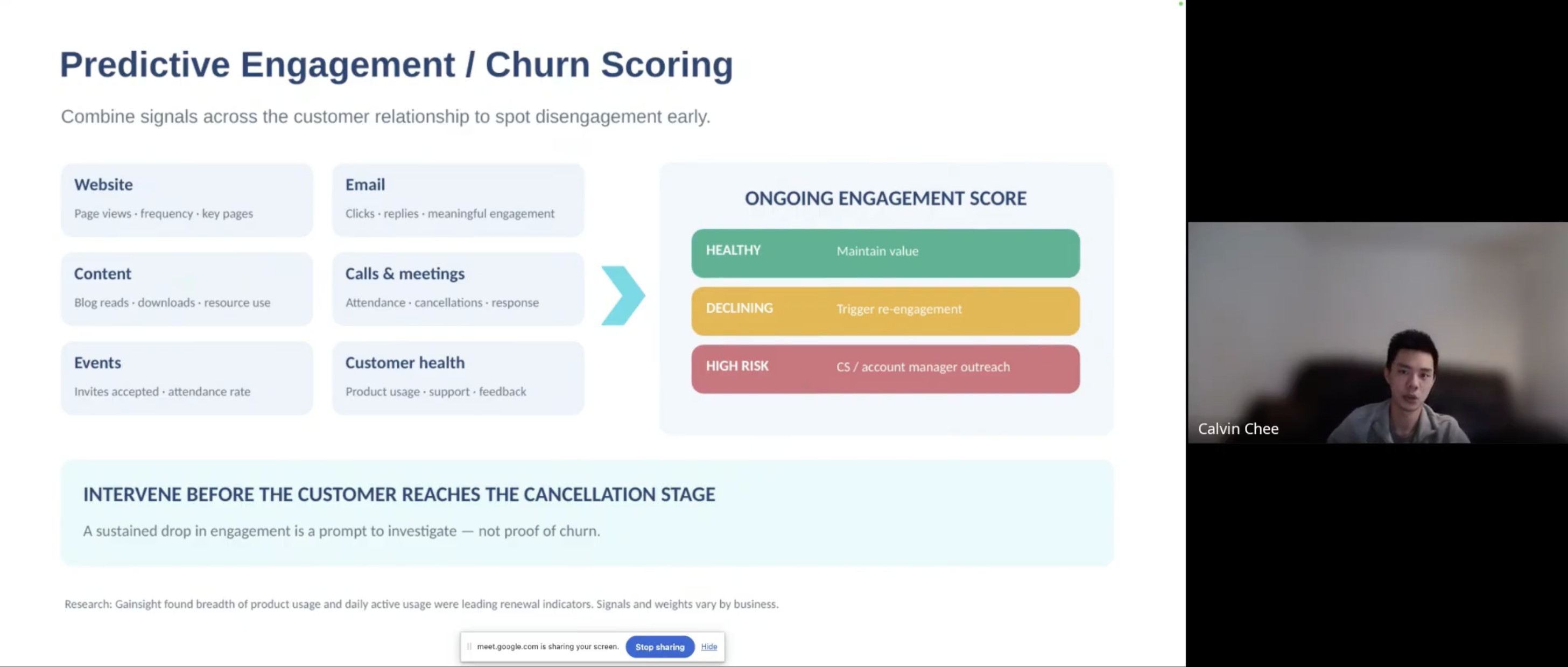
Customer health signals help your team recognise a possible change in the relationship before a cancellation conversation. They should combine relevant evidence, rather than assume that every missed webinar or unanswered email means the account is at risk.
Calvin's third idea was to connect engagement and customer context with a defined response. The purpose is to notice a potential problem early enough for someone to investigate. A health assessment should guide attention, while the account manager establishes what is happening and what help is needed.
For a SaaS business, usage of a capability tied to the customer's goal may be informative. For a professional services firm, progress against milestones, participation in reviews and unresolved delivery issues may matter more. Login frequency is not automatically meaningful for a relationship without a customer-facing application.
Support volume also needs context. More questions can reflect active adoption, while repeated unresolved issues may indicate frustration. A quiet account can be satisfied or disengaged. Look at the nature of the evidence and compare it with the customer's established pattern before assigning risk.
An illustrative model could distinguish stable accounts, accounts needing attention and accounts requiring urgent review. Define the evidence, responsible person, expected response and closure condition for each category. Calibrate the model against historical outcomes where possible, and review mistaken alerts as well as missed problems.
AutomateNow's customer success case study illustrates how post-sale processes can be designed around ownership and customer engagement. In practice, an alert should lead to a conversation about the customer's goal, not an immediate sales pitch for an additional service.
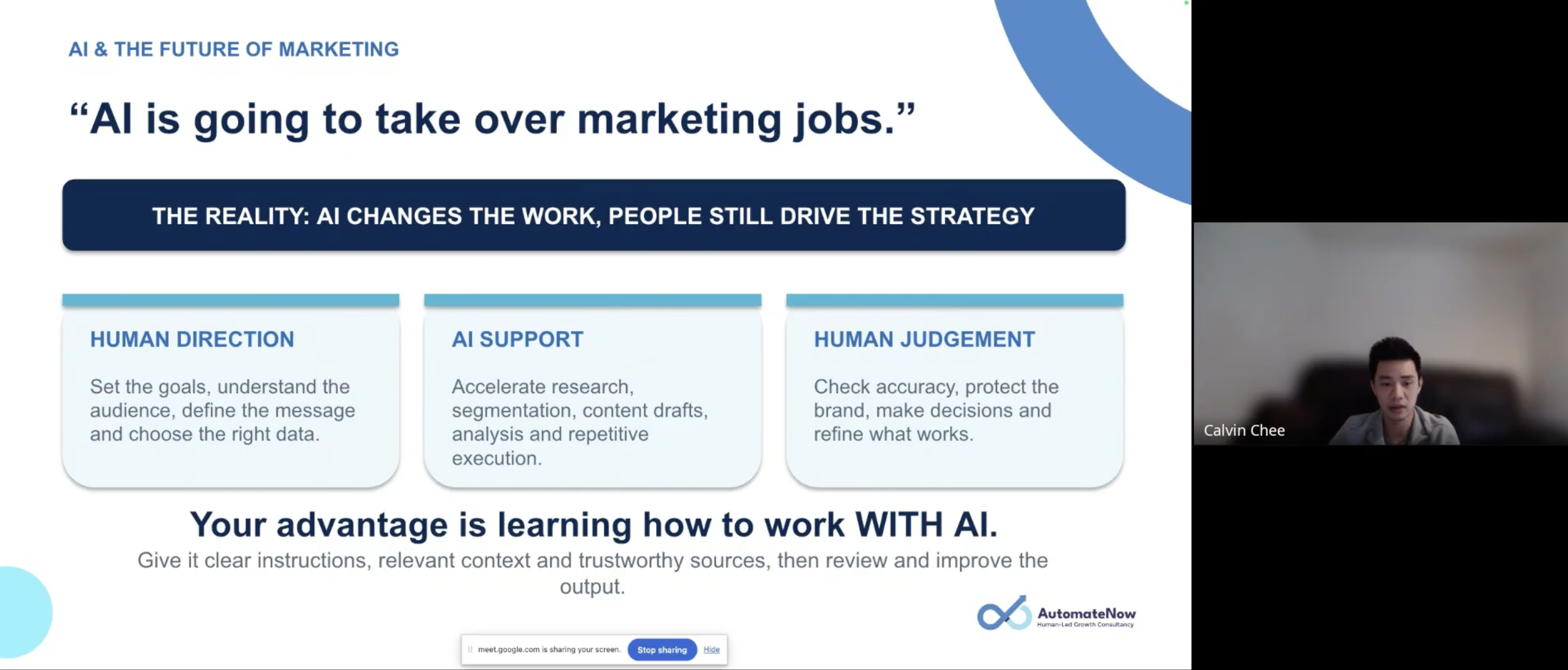
AI needs relevant, trustworthy context for the task you have chosen. For a nurture message, that could include the contact's organisation, role, stated problem, topic preference and important conversation history. Collecting more information is not automatically better than improving the accuracy of what the task needs.
Bart's webinar demonstration also highlighted business context: what your organisation offers, how your team works and how customers move through the buying process. A name and email address can identify a recipient, but cannot explain the relationship or the limits of an appropriate message.
Identify where customer status, communication preferences and relationship context are maintained. Check for duplicate records, stale details and conflicting definitions across systems. AutomateNow's data strategy approach starts with the business questions those records need to answer, then connects the relevant sources and responsibilities.
Assign someone to maintain quality after launch. Import standards, property definitions and integration reviews help prevent the same issues returning. HubSpot administration provides ongoing stewardship as teams, campaigns and processes change, rather than treating data cleaning as a one-off technical exercise.
Bring marketing, sales and service together to capture recurring questions, objections, service boundaries and examples of appropriate communication. A recorded discussion can be a starting point where recording and processing are appropriate, but the resulting guidance still needs an accountable owner and review.
Separate facts from assumptions and note when the guidance was checked. Include what the agent should avoid, when it should defer and which sources it may use. Broader HubSpot AI use cases should follow from these decisions, rather than expanding access to information without a defined purpose.
Measure value against the campaign's purpose and the next meaningful stage of the relationship. For acquisition, examine qualified conversations, accepted opportunities and eventual sales. For existing customers, assess progress towards agreed outcomes, renewal behaviour and reasons for leaving.
Opens and clicks can support diagnosis, but privacy mechanisms and automated security activity can distort them. A direct reply, a completed meeting and a documented qualification decision provide different evidence. Define those measures consistently so marketing and sales are discussing the same population and time period.
Cost per lead, or CPL, measures the cost of acquiring a lead under your stated definition. If you count qualified leads only, label that clearly. Customer acquisition cost, or CAC, relates to acquired customers and includes the marketing and sales costs defined in your model.
Include content preparation, configuration, data work, review time and AI credit consumption when evaluating the pilot. Use a consistent cost allocation and observation period. More meetings with substantially more effort might require a different decision from a similar result achieved with less operational load.
A before-and-after comparison can reveal a change, but cannot by itself isolate the effect of automation. Seasonality, staffing, the offer and other campaigns can affect results. Where practical, plan a comparable group and record differences in exposure, timing and customer profile.
With a small sample, present results as directional evidence. Keep examples of unsuitable handovers, unwanted messages and useful replies alongside aggregate metrics. A review of actual cases can reveal issues that an average conversion rate conceals, particularly when several different customer needs sit inside one campaign.
Start with one problem, one audience and one outcome you can assess. For example, you might test whether a topic-led journey improves the quality of conversations with integration enquirers. Choose audience size and observation time to match your database and sales cycle, rather than copying a universal pilot template.
Document the existing process, proposed change, success criteria and conditions for pausing. Confirm data availability, communication eligibility, ownership of responses and budget boundaries before activating customer-facing actions. The team should understand what the pilot is intended to teach, including results that would justify stopping it.
Test what happens when someone unsubscribes, becomes a customer, replies to sales or changes employer. Check incomplete records, conflicting interests and missing owners. Your team should know how to pause the campaign, correct a routing problem and prevent unnecessary duplicate follow-up.
After launch, collect numerical outcomes, team feedback and representative messages. Decide whether to expand, revise or stop based on communication quality, operational reliability and commercial evidence. If the foundation needs repair, resolve that before adding recipients; a larger audience makes an unclear process harder to inspect.
Ask your legal adviser or data protection lead to review the basis for processing, direct marketing rules, tracking, profiling, data sources and retention. For UK activity, this can include UK GDPR and PECR considerations; cross-border campaigns may require additional analysis of the relevant jurisdictions.
An AI data-use setting does not replace that assessment. Limit information to what the process needs, control access, respect communication choices and document responsibilities. These are organisational considerations, not individual legal advice. Use your organisation's circumstances to determine the legal and governance requirements before launch.
The webinar's three ideas connect around one practical aim: give people the context to respond appropriately. Marketing can develop the relevant topic, sales can act on a credible request and service can investigate a change in customer engagement. Clear ownership connects those stages.
Choose one point where communication currently loses continuity and examine it with the team. AutomateNow's business consultancy connects that examination with agreed priorities and an achievable path forward. Start with the decision you want to improve, then design the process, data and technology around it.
Prepared with AI assistance from an AutomateNow expert-led webinar. This draft requires editorial verification and approval before publication.
No. Behaviour-led nurturing can use prepared content and agreed rules. AI can support personalisation, but it does not remove the need for a sensible journey. AutomateNow helps define the process and responsibility for the next action before deciding which technology is useful.
An open alone is too weak a basis for judging sales readiness. Consider customer fit, the stated need and other credible signals. Agree the criteria with sales, then review them against actual conversations rather than treating a recorded interaction as proof of buying intent.
Focus first on the information needed for one chosen scenario, then improve its quality and ownership. You do not need to begin with every record. AutomateNow supports data assessment, cleaning and governance so future campaigns have a more reliable foundation.
Lower engagement is a reason to investigate, not proof that a customer will leave. Compare the change with the normal relationship and current project context. The account manager should establish the cause and agree useful support rather than relying on a score alone.
AutomateNow combines customer journey and data work with HubSpot configuration and team enablement. The scope should reflect the business problem and the decisions you need to improve. Begin with one scenario and an agreed outcome against which to assess a focused pilot.