Everyone is talking about artificial intelligence and almost nobody is talking about what is becoming genuinely scarce because of it.
Russell Dalgleish has spent over 25 years in technology. He launched the first HR SaaS solution in Europe in 1999. He worked in California in the early 2000s, watched the internet boom and bust, watched apps become compulsory and then forgotten, watched digital currency go from a curiosity to a religion and back again.
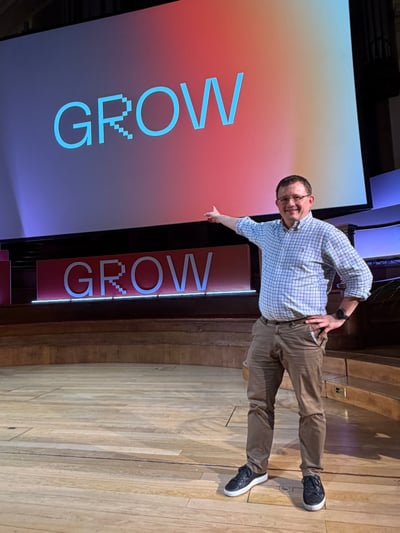
When he stood up at a recent leadership session at Level 39, Canary Wharf, his opening line was deliberate.
"Artificial intelligence isn't intelligent."
He was not dismissing it. He was grounding it. Because before you can decide how to use a technology well, you need to see it clearly for what it is.
We Have Been Here Before
Every decade or so, a new technology arrives and the business world loses its mind.
Websites. Enterprise software. Apps. Crypto. Each one arrived with the same energy. Urgency, FOMO, consultants promising transformation, and a wave of businesses spending money before they understood what problem they were actually solving.
Business leaders hear an anecdote about an early-stage AI breakthrough, mistake it for a mature use case, fear that they are missing out, plunge headlong into adoption, and end up with an implementation that falls short of expectations. MIT Sloan
Russell described this pattern with characteristic directness. The app wave cost one business owner £30,000 for an app nobody downloaded. The outsourcing wave sent entire functions offshore only for companies to discover they had lost control of their own operations. The digital currency wave made a handful of people extraordinarily wealthy and left many more confused about what they had invested in.
"If you think about AI as being this latest hype around creating wealth for American technology conglomerates, that's what's happening."
This is not cynicism. It is pattern recognition. And pattern recognition, applied honestly, is one of the most useful things a leader can bring to any technology decision.
The question is not whether AI is real. It is. The question is the same one it always was.
What problem are you actually trying to solve?
How to Decide When to Jump In
Russell's answer to the timing question is not a framework. It is simpler than that.
Play with it.
Not as a project. Not as a budget line. As genuine curiosity. Sit with it. Ask it questions that matter to your business. See what it does well and where it falls short. Let your team do the same.
"The best thing we can do is play with it. And if you play with it, your team will play with it."
He gave an example that made the room laugh and then think. Sitting in a cafe in Spain, he received a call from a friend who was an HR professional in a difficult spot. He pulled out his phone, spoke to his digital twin, an AI agent trained on everything he had ever written and published, and within minutes had a market analysis, a proposal, and a polished one-page brochure ready to send.
The following week, his friend had three inbound meeting requests.
"That's the practicality of AI. I just played with it. I didn't go for process automation. I just played with it."
The lesson is not that AI should run your business development. It is that the leaders who benefit most are the ones who experiment directly, stay close to the problem, and resist the urge to hand the whole thing to a supplier and hope for the best.
Too many people think of AI solely in terms of large language models when in fact purpose-built applications are better suited for addressing specific tasks. In many ways, a large language model is a ridiculously expensive way to solve certain problems. MIT Sloan
The right starting point is always the problem. Not the product.
The Part of AI Nobody Warns You About
There are two practical risks that came up in the room that most AI conversations skip entirely.
The first is legal exposure.
When an employee or former employee submits a subject access request, they are now entitled to everything that involves them. Every meeting recorded by an AI transcription tool. Every note generated by an AI assistant. Every conversation in which their name was mentioned and an AI was listening.
This is not a hypothetical. It is already happening.
"Be careful what you wish for when you say play with AI. If you start doing that, you are going to leave a trail. This is the very start of this."
If your business uses AI meeting tools, note-taking software, or any system that records and processes conversations, your legal obligations around data have expanded considerably. Most businesses have not yet caught up with the implications.
The second risk is contractual.
Every previous technology hype produced the same pattern of regret: businesses that moved fast without contracts, without ownership of their own data, without clarity about what a supplier was doing with their information. Websites where the developer owned the domain. Software built on handshakes instead of agreements.
"Make sure if you have someone building you AI agents, you have a contract with them so that you know if they are not there or if something happens, how you are covered."
AI is following the same pattern. Move carefully. Own your data. Know your contracts.
The Choice You Are Making Every Time You Open an AI Tool
One observation from the session that did not get enough attention was this.
Every time a business chooses which AI model to use, it is making more than a technical decision.
ChatGPT, Gemini, Claude, and every other model available today is trained on a different corpus of information, reflects different biases, and produces meaningfully different outputs for the same question. The choice of model shapes the answers your business receives, the decisions those answers inform, and the way your customers are described and understood.
"When you speak to one model with one company, you are making a business decision. And you are making an ethical decision. And you are making a social decision."
Most leaders have not thought about it in those terms. But the difference between a report produced by one model and the same report produced by another is not cosmetic. It reflects different assumptions, different training data, and different commercial relationships.
This does not mean avoid AI. It means choose deliberately. Understand what you are choosing and why. Treat it with the same seriousness you would apply to any significant supplier relationship.
What Is Actually Becoming More Valuable
Here is the point Russell made at the close of his session, and the one that stayed with the room longest.
AI creates more interactions than ever. But fewer that feel meaningful. When AI is used in uniform ways across an industry, it is no longer a differentiator. It is background noise. BLEUMAG
What stands out is what AI cannot replicate.
The ability to walk into a room and genuinely understand what the person across the table needs. The instinct to make an introduction because you remembered a conversation from three months ago. The trust that builds over time between people who have shown up for each other consistently.
Relational skills and empathy are performance drivers in 2026, essential for building strong connections in an AI-augmented sales environment. As AI handles transactional tasks, human skills become the differentiator. apollo
Russell was direct about this.
"I think we should get better at this rather than getting better at the AI. Because this is where the value is going to be."
He pointed to something he had noticed in the room that morning. A brief conversation about electrical contracting and data centres in Holland led him to realise he had a direct connection to the head of data centres for the largest organisation in Holland. That connection cost nothing. It required only that he was paying attention.
That is the skill. Not the prompt. Not the model. The attention.
"Get your children better at speaking to people, better at communicating, better at building trust, better at helping people. This is where the real value is going to be going forward."
What This Means for Sales Leaders Specifically
If you lead a sales team or a business that depends on winning trust with clients, the AI conversation is not primarily a technology conversation.
It is a positioning conversation.
AI hype is cooling and buyer scepticism is growing. In 2026, organisations will be called to deliver real value grounded in operational rigour, not empty promises. Evolving buyer behaviour means human expertise matters more than ever. forrester
The businesses that will win are not the ones with the best AI stack. They are the ones whose clients feel understood, whose teams ask better questions, and whose leaders are genuinely present in conversations rather than hiding behind automated sequences and AI-generated outreach.
AI is a tool. Use it deliberately, protect your data, own your contracts, and play with it enough to understand it properly.
But do not mistake it for the thing that actually closes deals.
That is still a human skill. And right now, it is in shorter supply than ever.
FAQ
Will AI replace salespeople?
Not the good ones. AI handles the transactional, the repetitive, and the predictable. What it cannot replicate is the ability to build genuine trust, read a room, remember what matters to a specific person, and make the kind of introduction that changes someone's trajectory. Those skills are becoming more valuable as AI makes everything else cheaper and more uniform.
How do I know when to invest in AI for my sales team?
Start by playing with it yourself. Not as a project, as genuine curiosity. Ask it questions relevant to your business. Test it against real problems. Once you understand what it does well and where it falls short, you will be in a much better position to make a deliberate investment rather than a reactive one.
What is a digital twin and should I build one for my business?
A digital twin in this context is an AI agent trained on your own published content, your thinking, your writing, and your expertise. It allows you to draw on your own perspective at scale. It is most useful for leaders with a significant body of published thought, but the principle applies more broadly to any business that wants to capture and deploy its own knowledge systematically.
Which AI model should my business use?
There is no single correct answer. ChatGPT, Claude, Gemini, and other models are each trained on different information and reflect different assumptions. The reports they produce on identical topics can differ meaningfully. Choose based on the type of work you need done, test outputs critically, and treat the choice as a deliberate business decision rather than a default.
How do I protect my business legally when using AI?
Prioritise contracts with any supplier building or running AI systems for you. Understand what data is being recorded, stored, and processed. Be aware that AI meeting and transcription tools create records that may be subject to data access requests. The legal landscape is still developing, but the risks are real and immediate.
How do I build trust with clients when everyone is using AI?
By being genuinely present rather than automated. Trust in sales has always been built through attention, consistency, and follow-through. In an environment where most outreach is AI-generated and most conversations feel templated, the leaders who listen carefully, remember details, and make meaningful introductions stand out immediately.
Is human connection a competitive advantage in sales in 2026?
Yes, and increasingly so. As AI handles more of the transactional work in sales, the differentiation moves to the parts AI cannot replicate: empathy, judgement, relationships, and trust. The businesses that invest in those human capabilities now are building an advantage that is genuinely difficult to compete with.